




Know exactly where to sit — before you buy
Detailed guides to 220+ of the world’s great stadiums and arenas: the best seats by event type, sections to avoid, shade and accessibility — so you book with confidence, then pair your tickets with a hotel nearby.
Most popular guides
Fan favourites Photo: Google MapsArena
The O2 Arena
London, England 20,000
The O2 Arena in London (capacity ~20,000; about 17,650 seated plus a standing/seated floor) is one of the busiest concert and event arenas in the world. Seating is simple: a standing or seated floor at the front, the Level 1 lower tier (blocks 101–118) wrapping it, premium suites and clubs on Levels 2 and 3 in between, and the high Level 4 upper tier (blocks 401–422) above. The best views are the front floor blocks (A1–A3) and the lower-tier blocks facing the stage; the blocks directly behind the stage (114–117) are normally not sold for concerts.
Seating guide Photo: NoUser / Google MapsMulti-sport
Wembley Stadium
London, England 90,000
Wembley Stadium is England's 90,000-seat national stadium and the second-largest in Europe — home to England internationals, the FA Cup final, NFL London games, and some of the world's biggest concerts. The bowl is a three-tier design: the lower tier (blocks 101–144), the middle Club Wembley tier (blocks 201–252, all premium hospitality) and the upper tier (blocks 501–552). Blocks are numbered clockwise from the halfway line. The best general views are the lower-tier long sides at the halfway line; Club Wembley offers the best comfort and sightlines; the upper tier is the best value with panoramic views.
Seating guide Photo: Steve White / Google MapsFootball
Tottenham Hotspur Stadium
London, England 62,850
Tottenham Hotspur Stadium (opened 2019, capacity 62,850) is an asymmetric bowl built for more than football. Its defining feature is the single-tier South Stand — at 17,500 seats the largest single tier in the UK, a steep 34-degree 'wall' modelled on Dortmund's Yellow Wall and the loudest end of the ground. A world-first retractable synthetic pitch slides away to reveal an NFL/concert surface beneath, so the same bowl hosts Spurs, the NFL London Series, boxing and major concerts (Beyoncé, Bad Bunny, Lady Gaga). For football the best balanced views are the West and East lower tiers along the touchline; the upper tier (500s) is the best value with clean panoramic sightlines.
Seating guide Photo: Ebrahim Kahlawi Hassan Mohamed / Google MapsFootball
Old Trafford
Manchester, England 74,310
Old Trafford, Manchester United's home since 1910 and nicknamed the "Theatre of Dreams", is the largest club football stadium in the United Kingdom with a capacity of approximately 74,310. The all-seater bowl is formed by four covered stands: the three-tier Sir Alex Ferguson Stand (North), the single-tier Sir Bobby Charlton Stand (South), the two-tier Stretford End (West) behind one goal, and the two-tier East Stand (the old "Scoreboard End") behind the other. The most expensive and best-sightline seats sit along the sides in the lower and middle tiers of the Sir Bobby Charlton and Sir Alex Ferguson stands at the halfway line, while the best atmosphere is behind the goal in the Stretford End, traditional home of United's most vocal supporters. The best value tends to be found higher up in the upper tiers of the Sir Alex Ferguson Stand and the East Stand, which offer elevated, panoramic views for lower prices. Away fans are housed in the corner between the Sir Bobby Charlton Stand and the East Stand.
Seating guide Photo: Priyanto Akhmad Solihin / Google MapsFootball
Anfield
Liverpool, England 61,276
Anfield, the home of Liverpool FC, holds approximately 61,276 spectators across four stands: the single-tiered Spion Kop (behind one goal), the two-tiered Anfield Road End (away end, behind the opposite goal), and the two long sides, the three-tiered Main Stand and the two-tiered Sir Kenny Dalglish Stand. The most prestigious and best-sightline seats run along the halfway line in the Main Stand and Sir Kenny Dalglish Stand, while the legendary Kop offers the loudest atmosphere. Best value typically comes from the upper Anfield Road End and the back of the Kop's upper section, though these sit furthest from the action. For concerts the pitch becomes the floor with the stage usually at one end, and the Anfield Road End is generally closed off behind the stage.
Seating guide Photo: Google MapsFootball
Ibrox Stadium
Glasgow, Scotland 51,700
Ibrox Stadium is the home of Rangers FC and one of the largest football grounds in Scotland, with an all-seater capacity of around 51,700. It is formed of four covered, continuous stands: the three-tiered Bill Struth Main Stand (south, including the elevated Club Deck), the two-tiered Sandy Jardine Stand (north, formerly the Govan Stand), the Copland Road Stand (east) and the Broomloan Road Stand (west). The best elevated, halfway-line views come from the Main Stand and the rear of the Sandy Jardine Stand, while the Copland Road Stand behind the goal is the loudest, most atmospheric area and tends to offer the best value. Away supporters are housed in the lower tier of the Broomloan Road Stand, towards the Sandy Jardine corner. Exact block numbering varies by source, so always confirm against the official Rangers ticketing map when booking.
Seating guide Photo: Rakesh Singh / Google MapsArena
AO Arena
Manchester, England 21,000
The AO Arena holds up to around 21,000 for concerts, with a full lower and upper tier wrapping 360 degrees around a floor that seats or, at around 6,200 standing, hosts a general-admission crowd. The best concert seats are in the lower-tier blocks facing an end stage and the front of the floor, while the upper tier (blocks 200 and above) climbs steeply and the top rows sit a long way back and high up. Formerly the MEN Arena and Manchester Arena, it is the city's flagship indoor venue for concerts, comedy, boxing and family shows.
Seating guide Photo: Google MapsArena
Barclays Center
Brooklyn, USA 17,732
Barclays Center in Brooklyn is a two-tier arena seating around 17,700 for Brooklyn Nets basketball and up to roughly 19,000 for concerts. The bowl is split into a Lower Level (the 100s, sections numbered roughly 1-31) wrapped by a 200 Level upper tier (sections in the 200s), with courtside seats, premium Loge Boxes (L1-L5) and a ring of luxury suites between the two decks. The best overall views for Nets games are the centre-court Lower Level sections (around 7, 8, 23 and 24), while the strongest value sits in the Lower Level corners and the lower rows of the 200 Level along the sides. Avoid the baseline sections behind the baskets and, for concerts, sections directly behind the stage. Premium hospitality includes the Calvin Klein Courtside Club and the 40/40 Club.
Seating guide Photo: Google MapsArena
United Center
Chicago, USA 20,917
The United Center holds about 20,917 for Bulls basketball and roughly 19,717 for Blackhawks hockey across a 100 (lower), 200 (suite) and 300 (upper) level layout. The huge 300 level is one of the steepest and largest upper decks in the NBA and NHL, so the building feels enormous, yet the crowd noise, especially for Hawks games, is ferocious. Lower-bowl 100-level seats and the first few 300-level rows offer the best balance of view and value. It is a workhorse venue for the Bulls, Blackhawks, concerts and family shows.
Seating guide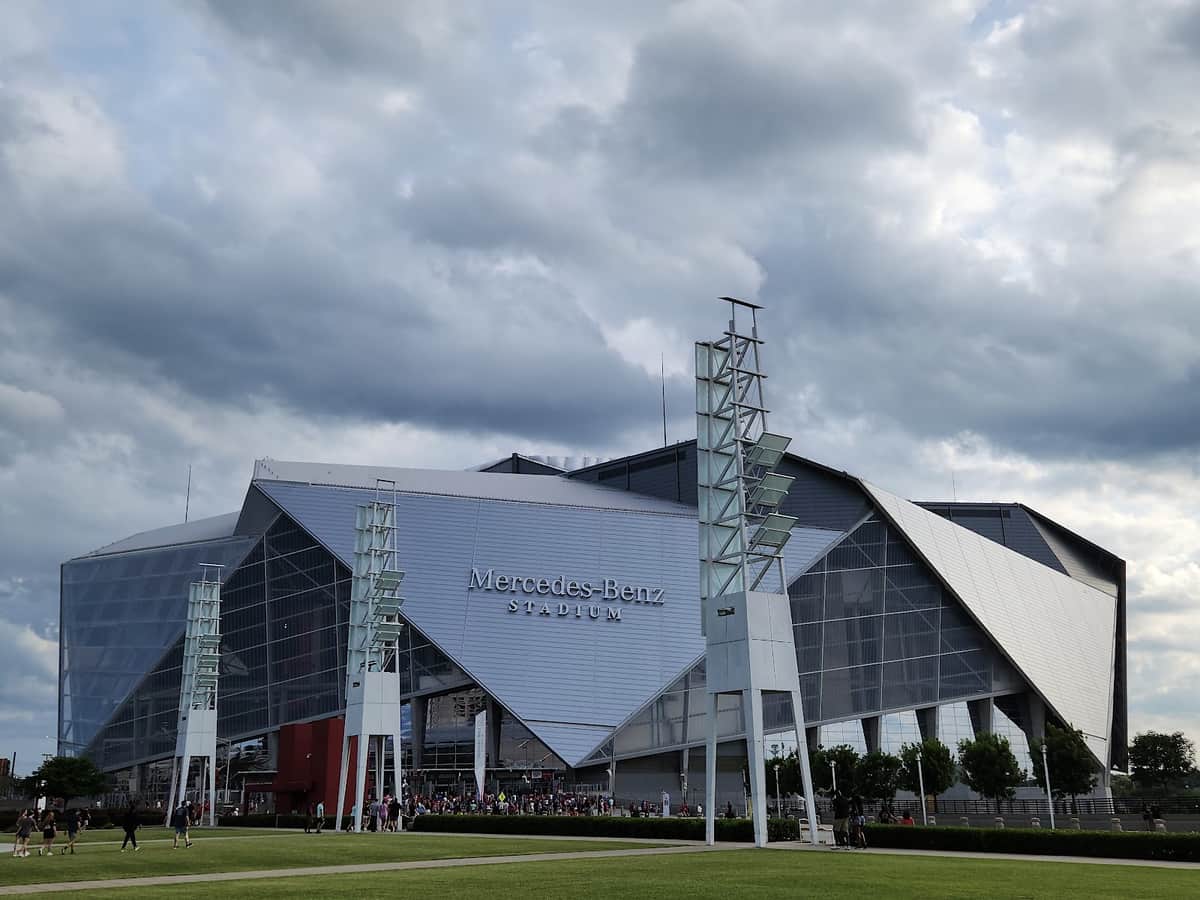 Photo: Alex Martin / Google MapsNFL
Mercedes-Benz Stadium
Atlanta, USA 71,000
Mercedes-Benz Stadium, opened in 2017 in downtown Atlanta, is a multi-purpose venue seating around 71,000 for NFL games (home of the Atlanta Falcons) and expandable to roughly 75,000 for major events. Seating is arranged across three main tiers: the 100 Level (lower bowl), the 200 Level (mezzanine, ringed with suites and club lounges) and the 300 Level (upper deck), all wrapped by the distinctive 360-degree "Halo Board" video ring beneath the retractable roof. The best overall views are along the lower-bowl sidelines around the 50-yard line (sections 107-113 on one side and 125-131 on the other, including club sections 108C-112C and 126C-130C), while the best value sits high on the 300 Level sidelines, which offer clean elevated views and the lowest prices. For Atlanta United matches the lower bowl can be curtained down to around 42,500, with the loudest atmosphere behind the goal in the supporters' sections (101-103 and 135-136). Premium options include the field-level Mercedes-Benz Club and Delta Sky360 Club in the lower bowl, the Harrah's Cherokee Club on the 200 Level, and numerous all-inclusive lounges and suites.
Seating guide Photo: PETER THOMPSON / Google MapsNFL
Soldier Field
Chicago, USA 61,500
Soldier Field is the lakefront home of the NFL's Chicago Bears and the smallest stadium in the league, seating approximately 61,500 for football following its 2003 interior rebuild behind the preserved historic colonnades. Seating is arranged over four tiers: the 100 Level (lower bowl), the 200 Level (mid-tier, including the premium United Club on the east side), the 300 Level (upper bowl) and the steep 400 Level (Upper West) above the west sideline. The best overall views are from the lower sideline sections between the 20-yard lines (west 128-146, east 101-117), while the best value tends to be the 300 Level west sideline (330-344), which offers honest, head-on sightlines at a fraction of lower-bowl prices. For concerts staged at the north end, the south end zone sections facing the stage head-on (119-126) and premium field packages are the most sought-after, while the 400 Level Upper West gives some of the most distant views.
Seating guide Photo: Randolfo Santos · / Google MapsTennis
Arthur Ashe Stadium
New York City, USA 23,771
Arthur Ashe Stadium, the main court at the USTA Billie Jean King National Tennis Center in Flushing Meadows, Queens, is the world's largest tennis stadium with a capacity of around 23,771. It is arranged in four distinct tiers stacked from the floor upwards: the Courtside (lower) level, the Suite level, the Loge level and the large Promenade (upper) level, all sitting beneath a retractable roof completed in 2016. The best overall views are from the Courtside boxes and Loge sections behind the baselines and along the sidelines close to the umpire's chair, while the best value is found in the lower rows of the Promenade level, where prices fall sharply but sightlines remain reasonable. For day sessions, the west and south sides (broadly Sections 47-58 and the matching Promenade sections) move into shade by mid-afternoon, whereas the highest Promenade rows feel very distant from the court. The standout recommendation is to sit as low as possible on whichever tier your budget allows and to favour baseline or near-baseline sections over the extreme corners.
Seating guideFootball
76 venues Photo: Jamshaid Ali / Google MapsFootball
Allianz Arena
Munich, Germany 75,000
The Allianz Arena, FC Bayern Munich's home, holds 75,000 for Bundesliga matches (including the standing Südkurve) and about 70,000 all-seated for international games, under its famous colour-shifting inflated-panel façade. Seating is three clean tiers — Unterrang, Mittelrang, Oberrang — with no pillars and excellent sightlines everywhere. The best seats are the central Mittelrang blocks on either sideline; Bayern's ultras stand in the lower Südkurve behind the south goal. The arena sits at Fröttmaning on the U6 metro, 20 minutes from central Munich.
Seating guide Photo: Enilton Fialho / Google MapsFootball
Allianz Parque
São Paulo, Brazil 43,713
Allianz Parque holds about 43,713 for football (and up to around 55,000 for concerts) in a compact, steep arena bowl with lower and upper rings close to the pitch. The behind-goal Gol Norte and Gol Sul ends drive the atmosphere, with the Mancha Alviverde ultras and the newer standing Geral area behind the north goal, while the side stands (arquibancadas and camarotes) hold the seated and premium areas. Central side seats give the best views; the goal ends give the noise. It is Palmeiras' home and one of São Paulo's premier concert venues.
Seating guide Photo: Google MapsFootball
Allianz Stadium
Turin, Italy 41,507
The Allianz Stadium — still widely called the Juventus Stadium — is a tight 41,500-seat, football-only bowl and one of the best atmospheres in Italy precisely because there is no athletics track. Juventus’ most passionate ultras fill the Curva Sud behind one goal, with the Curva Nord opposite, while the Tribuna Est and Tribuna Ovest run down the sides and hold the premium central seats. The steep rake and close pitch make almost every seat feel involved, and the covered roof keeps the weather off. Best overall views are the central Tribuna Ovest, with the Curva Sud for noise.
Seating guide Photo: char's top 5 / Google MapsFootball
American Express Stadium
Brighton (Falmer), England 31,876
The Amex is a clean, modern bowl where sightlines are good almost everywhere thanks to the pillar-free, dug-in design. The three-tier West Stand is the main/hospitality side (blocks W1 lower, W2 middle with executive boxes, W3 upper) and home to the 1901 Club premium lounges; opposite, the two-tier East Stand is the largest stand and holds the Family Stand in its lower tier (blocks E1). Behind the goals, the single-tier North Stand is the home singing end and the loudest part of the ground, while the single-tier South Stand houses the away support (blocks S1B-S1F, up to ~3,300 in the south/south-east corner). For the best all-round view, aim for the West or East upper tiers around the halfway line (W2/W3 D-F blocks are especially recommended); for atmosphere, the North Stand, where safe-standing rail seating is being extended. Concert history is light (Fatboy Slim, Rod Stewart), so it functions primarily as a football and rugby venue.
Seating guidePhoto: Priyanto Akhmad Solihin / Google MapsFootballAnfield
Liverpool, England 61,276
Anfield, the home of Liverpool FC, holds approximately 61,276 spectators across four stands: the single-tiered Spion Kop (behind one goal), the two-tiered Anfield Road End (away end, behind the opposite goal), and the two long sides, the three-tiered Main Stand and the two-tiered Sir Kenny Dalglish Stand. The most prestigious and best-sightline seats run along the halfway line in the Main Stand and Sir Kenny Dalglish Stand, while the legendary Kop offers the loudest atmosphere. Best value typically comes from the upper Anfield Road End and the back of the Kop's upper section, though these sit furthest from the action. For concerts the pitch becomes the floor with the stage usually at one end, and the Anfield Road End is generally closed off behind the stage.
Seating guide Photo: Yasin Ridoy / Google MapsFootball
BC Place
Vancouver, Canada 54,500
BC Place is a covered, downtown bowl where the retractable roof guarantees play whatever the weather. The lower bowl (200-level) sideline sections offer the best proximity and midfield views; the Club level (300s, sections 336-346) on Level 3 gives elevated central sightlines with lounge access; and the upper bowl (400s) is the cheapest but is usually curtained off for Whitecaps matches. The loudest support is the Southsiders and Curva Collective behind the south goal in sections 249-254 (with 253 general admission). The Whitecaps bench sits in front of section 213. For the 2026 World Cup the ground opened up to 52,497 and hosted seven matches, including two knockout games (a Round of 32 and a Round of 16). It is also a major concert venue - Ed Sheeran drew a record 65,061 and Taylor Swift closed her Eras Tour here - with the roof closed and an end-stage floor layout.
Seating guide Photo: Google MapsFootball
BMO Field
Toronto, Canada 30,000
BMO Field is an intimate, three-quarters-covered soccer bowl where almost every seat is close to the pitch. The West Stand is the main grandstand and, with the East upper deck, gives the best central side-on sightlines; the canopy over East, West and South means most of the ground stays dry, while the open North end and the pitch itself take the weather. The loudest support is the Toronto FC supporters' section behind the South goal (roughly sections 112-118), home to the Red Patch Boys, U-Sector and Inebriatti, where the drums and smoke live. Best value is the 200-Level sideline, which trades a little proximity for an elevated tactical view under cover. For the 2026 World Cup the ground was temporarily expanded to 45,736 with new upper stands over the North and South ends, both left open-air; it hosted six matches (five group games plus a Round of 32 knockout), the smallest venue at the tournament.
Seating guide Photo: Google MapsFootball
Borussia-Park
Mönchengladbach, Germany 54,057
Borussia-Park is Borussia Mönchengladbach's 54,057-capacity home, opened in 2004. Its character comes from German terrace culture: the Nordkurve's standing blocks (13–18) hold 14,079 fans and generate the matchday atmosphere, while the steep seated bowl, split into an Unterrang (lower tier, 35,053 seats) and Oberrang (upper tier, 18,989 seats), offers clean sightlines everywhere. Capacity peaks at 60,250 with both ends terraced and falls to roughly 46,000 in all-seated UEFA mode.
Seating guide Photo: Paul Smyth / Google MapsFootball
Celtic Park
Glasgow, Scotland 60,411
Celtic Park (also known as Parkhead) is the largest football stadium in Scotland, with a capacity of approximately 60,411. It is arranged around four stands: the towering two-tier North Stand (the biggest, holding around 27,000), the Jock Stein Stand behind one goal, the Lisbon Lions Stand behind the other goal, and the older single-tier Main (South) Stand which houses the dugouts, directors and TV gantry. The North, Jock Stein and Lisbon Lions stands wrap around three sides in a continuous two-tier bowl, generating the famous atmosphere, with the loudest home support traditionally in the Jock Stein Stand and the rail-seating "safe standing" section in the Lisbon Lions Stand. The best overall views are from the lower and middle North Stand around the halfway line; the best value comes from the upper tiers behind the goals (Jock Stein and Lisbon Lions upper). Away fans are housed in a corner of the Lisbon Lions Stand at the south-east of the ground.
Seating guide Photo: Nitin Surendrelal Vitoldás / Google MapsFootball
Cívitas Metropolitano
Madrid, Spain 70,460
The Cívitas Metropolitano holds around 70,460 and is arranged as a single steep, roofed bowl with three main tiers. The four sides are known as Tribuna (west main stand), Preferencia (east), Fondo Norte and Fondo Sur — the Fondo Sur behind the south goal is home to the Frente Atlético ultras and is the loudest section. Best all-round views are from the central Tribuna and Preferencia mid-tier; away fans are placed high in a corner between Fondo Norte and Preferencia. The venue also hosts major concerts and staged the 2019 UEFA Champions League final.
Seating guide Photo: adrian Gavin / Google MapsFootball
Craven Cottage
London, England 29,600
Craven Cottage has four contrasting stands: the historic, listed Johnny Haynes Stand along Stevenage Road (blocks A-K, home only), the vocal home Hammersmith End behind the north goal (blocks H1-H8), the Putney End behind the south goal (which also holds the away fans), and the huge new two-tier Riverside Stand along the Thames (blocks R01-R08 lower, R11-R18 upper). The Riverside Stand, reopened for 2024-25, has the best modern sightlines and the premium hospitality; the Hammersmith End is the cheapest big-atmosphere home area and the end Fulham attack in the second half. Away fans go in the Putney End (blocks P5-P7), a mix of home and away with decent noise. The old Johnny Haynes Stand has character but wooden bench seats and roof pillars that can restrict views. Craven Cottage does not stage stadium concerts; the redeveloped Riverside now runs year-round as the Fulham Pier leisure and dining destination.
Seating guide Photo: abderrahman Aznag / Google MapsFootball
De Kuip (Stadion Feijenoord)
Rotterdam, Netherlands 51,117
De Kuip, officially Stadion Feijenoord, is Feyenoord's iconic oval bowl in Rotterdam, opened in 1937 and converted to an all-seater of around 51,117 in 1994. Its two free-hanging tiers (a lower "first ring" and an upper "second ring") wrap continuously around the pitch across four named stands: the Gerard Meijer Tribune and the Willem van Hanegem Tribune behind the goals, and the long-side Maastribune and Olympiatribune. The most coveted seats are the lower-ring central blocks along the halfway line on the Maastribune and Olympiatribune, while the loudest atmosphere comes from Vak S behind the goal on the Gerard Meijer Tribune. Best value is generally the upper second ring, which delivers a sweeping, elevated view of the whole pitch at lower prices. For football, capacity is reduced to roughly 47,500; for concerts the bowl holds up to around 50,000.
Seating guide Photo: Deutsche Bank Park / Google MapsFootball
Deutsche Bank Park
Frankfurt, Germany 58,000
Deutsche Bank Park, still affectionately called the Waldstadion, holds around 58,000 for Bundesliga matches and is home to Eintracht Frankfurt, whose European nights are famous for their noise and colour. The Nordwestkurve behind one goal is the ultras’ terrace and the beating heart of the support, with the Haupttribüne (main stand) on the west side and the Gegengerade opposite. Standing areas convert to seats for international games, lowering capacity. The forest setting, membrane roof and glowing video cube give it a distinctive feel, and central Haupttribüne seats offer the best all-round view.
Seating guide Photo: Paul Marriott (High flying drone shots) / Google MapsFootball
Elland Road
Leeds, England 37,645
Elland Road holds about 37,645 in an all-seated bowl split across four distinct stands: the Don Revie (North) Stand, the huge double-decker East Stand, the John Charles (West) Stand and the Norman Hunter South Stand. The North Stand, historically the Kop, is the beating heart of the atmosphere behind the goal, while the John Charles and East Stands offer the best elevated halfway-line views. Away fans are placed in the south-east corner. It is used almost exclusively for Leeds United matches, with an approved expansion set to lift capacity well beyond its current figure.
Seating guide Photo: حسابي ميسي بيج تايم 105 / Google MapsFootball
Emirates Stadium
London, England 60,704
Arsenal's Emirates Stadium (capacity 60,704) is a four-tier bowl in north London. From the pitch up: the Lower Tier (blocks 1–32), the premium Club Level (blocks B41–B84), a Box Level of executive boxes, and the Upper Tier (blocks 91–134). Blocks are numbered clockwise. The best balanced views are the West Stand long-side blocks at the halfway line; the Club Level gives the best comfort; the front rows of the Upper Tier give a clean 'TV-style' view; and away fans sit in the south-east corner (lower-tier blocks 20–22 and the upper tier above).
Seating guide Photo: Thomas Paar / Google MapsFootball
Ernst-Happel-Stadion
Vienna, Austria 50,865
The Ernst-Happel-Stadion is Austria's 50,865-seat national stadium, a 1931 classic modernised for Euro 2008 and run by the City of Vienna. Three tiers in six lettered sectors rise under a roof that has covered the stands since 1986, with an athletics track keeping the front rows further from the pitch than at modern football-specific grounds. It hosts Austria internationals, Vienna's clubs' big European nights and major concerts, and includes a 900-person VIP club with its own private lift.
Seating guide Photo: Carolina Gómez / Google MapsFootball
Estadio Akron
Guadalajara (Zapopan), Mexico 49,813
Estadio Akron is built as two continuous rings — Planta Baja (lower) and Planta Alta (upper) — split into cabeceras behind the goals (Cabecera Inferior/Superior Norte and Sur) and laterals down the sides (Lateral/Preferente Inferior and Superior, Oriente and Poniente). The lower sideline (Lateral/Preferente Inferior) around the halfway line is the best football seat, close and level; the Poniente (west) side is the main preferente flank. The upper cabeceras (Cabecera Superior Norte/Sur) are the cheapest tickets and, thanks to the steep, compact bowl, still give a surprisingly close view for the price. Chivas' animación — the barras rooted in the Legión 1908 and La Irreverente tradition — drive the noise from a lower cabecera behind the goal, the section historically left without fixed seats so fans could jump; the club has since fitted butacas there. Premium sits between the rings in 300-plus private palcos and the Club Chivas lounge. For World Cup 2026 it plays as 'Estadio Guadalajara' with four group-stage matches and no knockout games.
Seating guide Photo: Google MapsFootball
Estadio Alberto J. Armando (La Bombonera)
Buenos Aires, Argentina 54,000
La Bombonera holds around 54,000 in a uniquely steep bowl of three stacked seating tiers (plateas baja, media and alta) on three sides, with a flat wall of executive boxes (palcos) on the fourth. The behind-goal populares are the standing-style home ends, and the north popular is the domain of Boca's most fervent support, La 12. Seated plateas along the sides give the best views, while the palcos offer the main hospitality option for visitors, since populares are effectively for members. It is one of the most atmospheric football grounds on earth, home to Boca Juniors and the Superclásico against River Plate.
Seating guide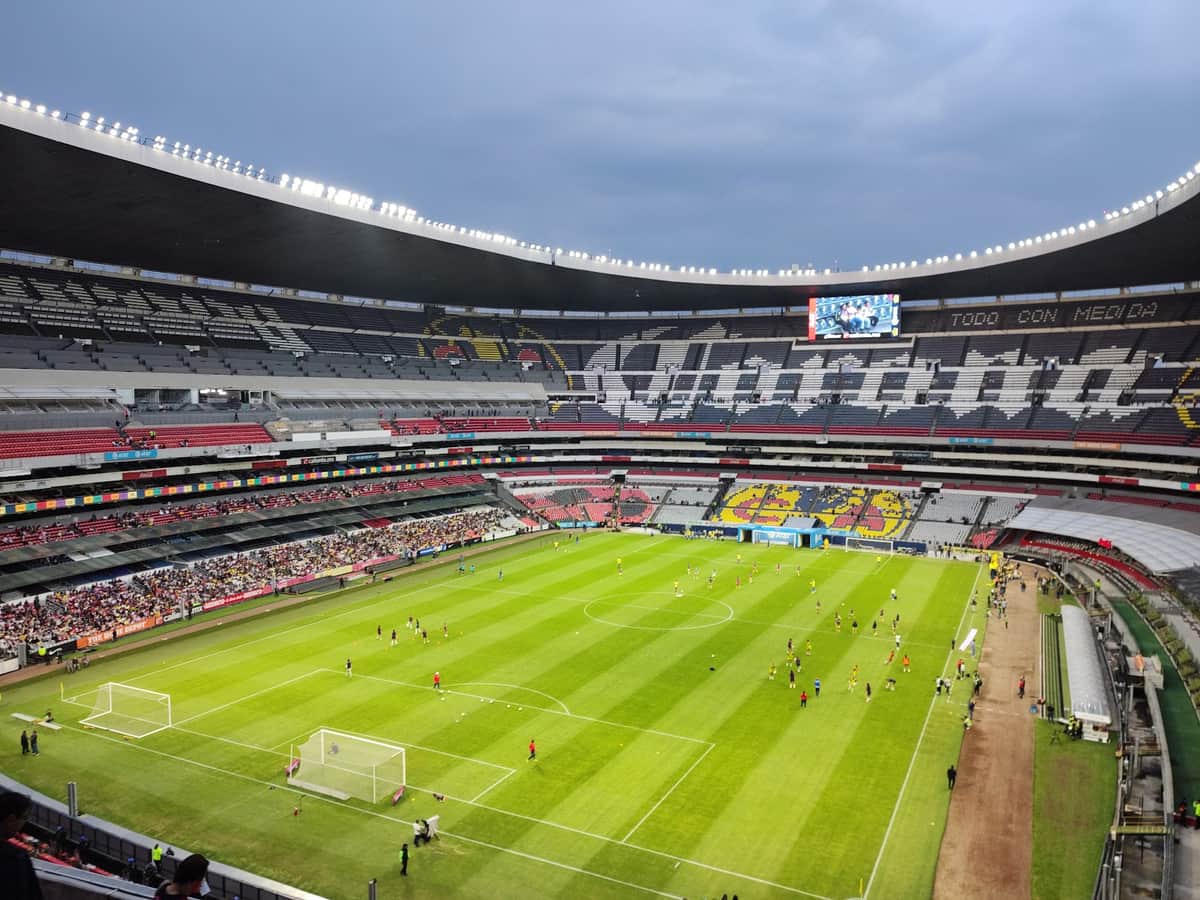 Photo: Victor Huerta / Google MapsFootball
Estadio Azteca
Mexico City, Mexico 87,523
The Azteca's lower ring (level 100 — Lateral 100 down the sides, Norte 100 and Sur 100 behind the goals) gives you the closest, most level football; the sideline Lateral 100 seats around the halfway line are the best in the house. Above the lower ring sits the premium Plateas 200 band and then the near-continuous wall of palcos (executive boxes) that separates the decks. The upper ring — Lateral 300 and Cabecera 300, with Alto Norte and Alto Sur (the old level 400) at the very top — is where the value lies: it is steep and high, but the sightlines stay honest because the bowl points everything at the grass. Club América's hardcore support, led by La Monumental, packs the north end (historically the Cabecera Norte, now up in the Alto Norte), so that is the loud end; for World Cup 2026 the ground is branded 'Estadio Banorte' commercially but plays as 'Mexico City Stadium' under FIFA rules, with reserved seating and no barras. For concerts the pitch becomes a floor GA/seated area and one end is closed off behind the stage, at which point the covered western Lateral and Plateas offer the best mix of sound and sightline.
Seating guide Photo: Zavaleta 74 / Google MapsFootball
Estadio BBVA
Monterrey (Guadalupe), Mexico 53,500
Estadio BBVA is a tight, modern bowl split by compass point: Poniente (PTE, west) and Oriente (OTE, east) down the long sides, Norte (NTE) and Sur (STE) behind the goals, with lower-deck sections in the 100s (Nivel 1) and upper-deck sections in the 200s. The lower sidelines (PTE 1xx / OTE 1xx) are the best football seats — the first row is roughly nine metres from the pitch, closer than almost any Mexican ground. Between the decks run the suites (Nivel 1 and 2, around 324 boxes) and about 4,500 club seats. The upper deck (PTE/OTE 2xx down the sides, NTE/STE 2xx behind the goals) is the value tier, and the north-and-upper stands also get the Cerro de la Silla mountain view over the open south end. Rayados' hardcore support, La Adicción, backs the team from the north behind-goal general, having moved up to the upper cabecera (the 'general' zone facing the screens); that is the loud end. For World Cup 2026 it plays as 'Estadio Monterrey' with four matches including a Round of 32.
Seating guide Photo: Rosendo Javier Bravo / Google MapsFootball
Estadio Benito Villamarín
Seville, Spain 60,721
The Benito Villamarín holds around 60,721 and is arranged around the huge three-tier Gol Sur behind the south goal, with the Preferencia (main west side), Tribuna, and Gol Norte / Fondo completing the bowl. The Gol Sur is where the most fervent Betis support — including the Supporters Gol Sur — is concentrated. The best views are from the central Preferencia; away fans are placed high in a corner. The ground is one of Spain's largest all-seaters and known for a genuinely raucous home crowd.
Seating guide Photo: Ale Ferrari / Google MapsFootball
Estadio Centenario
Montevideo, Uruguay 60,235
Estadio Centenario is football's original cathedral - an uncovered 1930 amphitheatre where every seat is open to the sky. The Tribuna Olímpica on the east side is the three-tier main grandstand with the best central, side-on view and the Football Museum and Torre de los Homenajes beneath it; the Tribuna América opposite (west) holds the official box, VIP palcos and press. The two ends - Colombes to the north and Amsterdam to the south - are the cheap, steep 'populares' where the loudest hinchadas gather; for a clásico the two sets of fans typically split these ends. Because the bowl is an amphitheatre, the behind-goal ends sit further back and higher, and with no roof anywhere the weather is always a factor. It hosts Uruguay internationals and the biggest Peñarol and Nacional finals and derbies, and is slated for a roof and a rise to around 63,000 ahead of a commemorative match at the 2030 World Cup centenary.
Seating guide Photo: Mario Fernando / Google MapsFootball
Estádio da Luz
Lisbon, Portugal 64,642
The Estádio da Luz holds around 64,642 across three continuous tiers of red seating, all under the arched roof. Portuguese stands are known as bancadas and the ground is divided by numbered sectors, with the topo (end) behind one goal home to Benfica ultras such as the No Name Boys and Diabos Vermelhos. Best views are from the central side sectors in the first and second tiers; away fans are placed in a corner. Nicknamed A Catedral, it also hosts major concerts and was the venue for the 2014 and 2020 Champions League finals.
Seating guide Photo: SF VL / Google MapsFootball
Estadio de la Cerámica
Vila-real, Spain 23,008
Estadio de la Cerámica (still widely called El Madrigal) is an intimate 23,000-seat ground where nearly every seat is close to the action. The Tribuna on the west side is the main stand — dugouts, players' tunnel and the air-conditioned executive boxes — with the two-tier Preferencia (the east side, also labelled Grada Este) facing it and offering the best-value side-on views. Behind the south goal, the single-tier Fondo Sur Cubierto is the home end where the peñas and the Grada de Animación bring the drums, flags and Yellow Submarine choreographies. The eye-catching Fondo Norte behind the north goal rises over two tiers, its enormous upper 'balcony' amphitheatre reserved for visiting supporters on big Category A and European nights. Sightlines are honest and near-continuous now the bowl is roofed; the only real compromises are the very high, set-back rows of that Fondo Norte upper deck and the flat front rows directly behind each goal.
Seating guide Photo: Libni Espinoza / Google MapsFootball
Estádio do Dragão
Porto, Portugal 50,033
The Estádio do Dragão holds around 50,033 in a two-tier bowl of blue seats, with the long side stands known as Bancada Nascente (east) and Bancada Poente (west) and the ends as Topo Norte and Topo Sul. The Super Dragões ultras occupy one topo behind the goal and lead the atmosphere. Best views come from the central side bancadas; away fans are placed in a corner or end section. Built for Euro 2004, it is regularly used for Portugal internationals and major matches.
Seating guide Photo: Harmony Falls / Google MapsFootball
Estádio do Maracanã
Rio de Janeiro, Brazil 78,838
The Maracanã holds about 78,838 as an all-seater, arranged in a lower ring (cadeiras inferiores) and an upper ring (cadeiras superiores) split around the four sides: Norte, Sul, Leste and Oeste. The behind-goal Norte and Sul ends hold the organized supporters (torcidas organizadas) and are the loudest, most intense areas, while the Oeste (west) side is the main stand with the premium seating and camarotes. Central Oeste and Leste seats give the best all-round views; the upper ring offers a sweeping panorama of the whole bowl. It hosts Flamengo, Fluminense, cup finals and the Brazil national team.
Seating guide Photo: Claudivam Flaviano / Google MapsFootball
Estádio Governador Magalhães Pinto (Mineirão)
Belo Horizonte, Brazil 61,846
The Mineirão holds around 61,846 as an all-seater in a continuous two-tier bowl, wrapped by its historic exterior ring of columns. The lower ring, added when the pitch was lowered for 2014, brings fans close to the action, while the upper ring gives a sweeping covered panorama; the behind-goal ends host the most passionate support. Central side seats offer the best views and the upper ring the best panoramas. It is now primarily the home of Cruzeiro, after Atlético Mineiro moved to their own Arena MRV in 2023, and it hosts finals, the Brazil national team and concerts.
Seating guide Photo: Pedro Figueiredo / Google MapsFootball
Estádio José Alvalade
Lisbon, Portugal 50,095
The Estádio José Alvalade holds around 50,095 in a steep two-tier bowl famous for its multicoloured seating and mosaic exterior. Portuguese stands are bancadas divided by numbered sectors, with the topo (curva) behind one goal home to Sporting ultras such as the Juventude Leonina and Torcida Verde. Best views come from the central side bancadas; away fans are placed in a corner. Built for Euro 2004, it also hosts major concerts and Portugal internationals.
Seating guide Photo: Yanina Fernandez / Google MapsFootball
Estadio Más Monumental
Buenos Aires, Argentina 85,018
The Más Monumental holds around 85,018 across four great stands: San Martín (the main west side, the oficial stand), Belgrano (east), plus the behind-goal ends Sívori (north) and Centenario (south). The San Martín and Belgrano sides carry the tiered plateas (bajas, medias and altas), while the Sívori and Centenario ends hold the populares, the standing-spirited home support that generates the wall of noise for River. A new low pitch-level ring, added when the running track was removed, puts front rows closer than ever. It is the home of River Plate and a frequent host of the Argentina national team and huge concerts.
Seating guide Photo: Rasaq Bashir / Google MapsFootball
Etihad Stadium
Manchester, England 61,038
The Etihad Stadium (formally the City of Manchester Stadium) is the home of Premier League club Manchester City and one of the UK's largest concert venues, seating around 61,000 for football following the major North Stand redevelopment. It is a continuous oval bowl made up of four stands: the East Stand (long known as "the Kippax"), the Colin Bell Stand on the West side, the South Stand, and the redeveloped North Stand, now named the Pep Guardiola Stand. The two side stands (East and Colin Bell) carry three tiers and offer the best balanced, side-on views, with the lower tiers and the rear of the side stands giving the best value, while the loudest home support traditionally gathers in the South Stand corner and lower East. The West-side Colin Bell Stand is the premium stand, housing the dugouts, hospitality lounges and executive boxes. Away fans are housed in one corner of the South Stand, and the North/Pep Guardiola Stand is the traditional family area; for concerts the pitch is converted to standing and reserved seating, with the stage usually at the North end.
Seating guide Photo: Kekko Segneri / Google MapsFootball
Gewiss Stadium
Bergamo, Italy 24,950
Gewiss Stadium (renamed New Balance Arena in 2025) is a tight, rebuilt four-stand bowl where the home end is the Curva Nord 'Federico Pisani' — Atalanta's ultras and the loudest, roughly 9,000-seat covered end behind the north goal. The main grandstand (Tribuna Centrale/UBI Banca, west side) holds the hospitality, sky boxes and pitch-view seats and gives the best central sightlines; the Tribuna Rinascimento is the east stand along Viale Giulio Cesare, most of it now roofed with only the lower parterre left uncovered. The Curva Sud 'Morosini', rebuilt and reopened in September 2024, is the second home end and holds the away section in its south-west corner (about 1,300–1,500 visitors). As an Italian ground it is all-seater — there are no German-style standing terraces — so the same layout is used for Serie A, European nights and the occasional Italy international. Strict ID rules apply: your name and document must match your ticket or you won't be admitted.
Seating guide Photo: Mikael 90300 / Google MapsFootball
Groupama Stadium
Lyon, France 59,186
The Groupama Stadium — also known as the Parc OL — holds around 59,000 and is the home of Olympique Lyonnais, built without a track so fans sit close to the pitch. OL’s ultras and loudest support fill the Virage Nord behind one goal, with a second lively virage at the south end, the main tribune on one side and the presidential/premium seating centrally. The floating roof, night lighting and steep tiers create a strong atmosphere, and central main-tribune seats give the best all-round view. It hosts French internationals, European finals and concerts too.
Seating guide Photo: Olaf Kersting / Google MapsFootball
Hampden Park
Glasgow, Scotland 51,866
Hampden Park holds around 51,800 and is the home of the Scotland national team, the Scottish Cup and League Cup finals, and Queen’s Park. The single continuous tier wraps the whole pitch under a cantilever roof, with the North and South stands down the sides holding the halfway line and premium seats, and the East and West ends behind the goals housing the most vocal support. There is no running track in normal football mode, so sightlines are reasonable, though the bowl’s shallow lower rows sit a touch back from the pitch. The best central views are from the North or South Stand.
Seating guidePhoto: Google MapsFootballIbrox Stadium
Glasgow, Scotland 51,700
Ibrox Stadium is the home of Rangers FC and one of the largest football grounds in Scotland, with an all-seater capacity of around 51,700. It is formed of four covered, continuous stands: the three-tiered Bill Struth Main Stand (south, including the elevated Club Deck), the two-tiered Sandy Jardine Stand (north, formerly the Govan Stand), the Copland Road Stand (east) and the Broomloan Road Stand (west). The best elevated, halfway-line views come from the Main Stand and the rear of the Sandy Jardine Stand, while the Copland Road Stand behind the goal is the loudest, most atmospheric area and tends to offer the best value. Away supporters are housed in the lower tier of the Broomloan Road Stand, towards the Sandy Jardine corner. Exact block numbering varies by source, so always confirm against the official Rangers ticketing map when booking.
Seating guide Photo: cohaqu kirii / Google MapsFootball
International Stadium Yokohama
Yokohama, Japan 72,327
Nissan Stadium (officially International Stadium Yokohama) is a 72,000-seat two-tier bowl with a running track, home to Yokohama F. Marinos. The Main Stand on the west side holds the tunnels, benches, press and the premium SS seats along the halfway line; the Back Stand opposite (east) is the best-value side-on view and also carries a supporters section on the north side of its upper deck. Behind the goals are the ends, and the South goal-back is the base of the Tricolore Pride ultras, whose home unreserved (jiyu) sections fill both tiers there. Marinos price by category — SS on the main stand, then SB and S Block on the sides, and cheap unreserved home and away seats behind the goals. Because the athletics track pushes seats back, the upper deck and the halfway-line main stand give the best football views, while the lower front rows and the upper goal-end corners are the most distant. For concerts and rugby the same bowl is used with a stage or full pitch.
Seating guide Photo: Stavros Kal / Google MapsFootball
Johan Cruijff ArenA
Amsterdam, Netherlands 55,865
The Johan Cruijff ArenA is the Netherlands' largest stadium and the home of AFC Ajax, with a football capacity of approximately 55,865 set within a continuous, modern bowl design rather than four separate stands. Seating is arranged across three tiers: the lower Eerste Ring (first ring, blocks roughly in the 1-29 and 101-129 series), the upper Tweede Ring (second ring, blocks in the 400 series), with a band of skyboxes, business seats and VIP lounges between the two main rings. The best overall views come from the lower-tier long sides around the halfway line (blocks in the 105-106 and 120-121 area), while the best value typically sits in the upper Tweede Ring long sides (blocks around 405-406 and 420-421), which offer a wide, elevated view at a lower price. The loudest home atmosphere is behind the goal with the F-Side and VAK410 supporters (blocks roughly 125-129 and 425), and away fans are housed in the North-side second ring (around blocks 416-417). A retractable roof allows the venue to host football, American football and major central-stage concerts that can lift capacity towards 71,000.
Seating guide Photo: Geo Kip / Google MapsFootball
Karaiskakis Stadium
Piraeus, Greece 33,334
Karaiskakis Stadium is Olympiacos' steep, intimidating home in Neo Faliro, Piraeus — a compact ~33,000 all-seater rebuilt in 2004 that keeps the crowd tight to the pitch. The two-tier West Stand is the main stand, with the dugouts, tunnel, press and the 40-plus VIP skyboxes; the large single-tier East Stand faces it and carries the white 'OLYMPIACOS FC' seat mosaic. Behind the north goal is the North Stand and Gate 7 (Thyra 7) — home to Greece's most famous and ferocious ultras, and to the twenty-one black seats shaped as a '7' that memorialise the 1981 Gate 7 disaster. The South Stand sits opposite, with visiting fans placed in its south-west corner (around blocks 26-27). Best sightlines are the central upper West and East; the East offers the best value side-on view; and Gate 7 is where you go for the noise. Worst compromises are the flat front rows behind the goals, the angled away corner, and the fact that Gate 7's huge tifos can block the far end.
Seating guide Photo: Marco Recalde / Google MapsFootball
King Baudouin Stadium
Brussels, Belgium 50,093
The King Baudouin (the old Heysel, rebuilt in 1995) is Belgium's national stadium, arranged as four colour-coded tribunes around an athletics track. Tribune 1 (Red) is the main stand on the west side with the tunnels, hospitality and the best central view; Tribune 3 (Green) is the opposite side and the best-value side-on seat; Tribunes 4 (Blue, north) and 2 (Yellow, south) sit behind the goals, with the home Belgian support loudest in Tribune 4 and the away allocation placed in the lower corner of Tribune 2 nearest the main stand. Blocks are numbered counter-clockwise and from the bottom up, with rows running from 1 at pitch level. Because a running track separates every stand from the pitch, the upper tiers usually give a better football view than the lower front rows. For concerts the pitch becomes a standing floor with Golden Circle and Floor blocks in front of a stage at one end.
Seating guide Photo: Artur Ziembaczewski / Google MapsFootball
King Power Stadium
Leicester, England 32,259
The King Power is a modern, fully enclosed single-tier bowl with four continuous stands: the West Stand (main stand and hospitality), the East Stand opposite, the North Stand (family) and the South Stand, known as the Spion Kop. Blocks run clockwise around the bowl (A to L, plus the Kop's SK blocks), and because it is single-tier with filled corners, sightlines are good almost everywhere. The Spion Kop, especially official singing section SK1, is the loudest home area, while the West Stand has the priciest, most comfortable seats but a quieter feel due to hospitality. Away fans are tucked into the north-east corner between the North and East stands (blocks M1-M4). Ahead of 2025-26 the club installed rail seating for safe standing across around 5,600 seats, and the ground has hosted big concerts such as hometown band Kasabian.
Seating guide Photo: London Stadium (former Olympic Stadium) / Google MapsFootball
London Stadium
London, England 62,500
London Stadium holds about 62,500 for West Ham United, making it one of the largest club grounds in England. Seating is split across a continuous lower and upper tier, with the stands named after club legends: the Bobby Moore Stand and Sir Trevor Brooking Stand behind the goals, and the long Billy Bonds Stand and West Stand down the sides. The best atmosphere and views come from the lower tier around the halfway line and the Bobby Moore Lower home end, while the athletics-legacy layout means the very back of the upper tier and the far corners feel a long way from play. It is used chiefly for West Ham home matches, plus summer concerts and athletics meetings.
Seating guide Photo: Jose Luis / Google MapsFootball
Mestalla
Valencia, Spain 49,430
Mestalla holds roughly 49,430 in an exceptionally steep, compact bowl split into Tribuna (west main stand), Preferencia (east), Gol Norte and Gol Sur behind the goals. The Curva Nord / Gol Norte is the home of the Yomus and other ultra groups and is the loudest end. The best views come from the elevated central Tribuna and Preferencia, while away fans are usually tucked into an upper corner of the Gol Sur. The steepness means even upper seats feel close, though the top rows are a long climb.
Seating guide Photo: MHP Arena / Google MapsFootball
MHPArena
Stuttgart, Germany 60,058
The MHPArena is a roofed, football-only bowl where the home end is the Cannstatter Kurve — VfB Stuttgart's ultras (Commando Cannstatt 97) and the huge lower standing terrace of around 8,000. The long sides are the Haupttribüne (Main Stand, on Mercedesstraße, holding the VIP lounges and press) and the Gegentribüne (opposite, the only stand with a small third tier). The Untertürkheimer Kurve is the opposite curve and houses the away section, with visitors entering through blocks 61–65. Domestic games run at 60,058 with roughly 11,000 rail-seat standing places; for UEFA and international fixtures those convert to seats and capacity falls to about 54,812. Bowl geometry and full roof cover mean there's barely a bad seat — the central Gegentribüne and Haupttribüne give the best value side-on views. Concerts use an end stage with a standing pitch, so the far curve behind the stage becomes restricted or unused.
Seating guide Photo: Chris Eley / Google MapsFootball
Molineux Stadium
Wolverhampton, England 31,750
Molineux is built from four individual stands rather than a bowl: the two-tier Stan Cullis Stand (North Bank) behind one goal, the vocal single-tier Sir Jack Hayward Stand (South Bank) behind the other, and the long Steve Bull and Billy Wright stands down the sides. The best all-round sightlines are high up in the Billy Wright or Steve Bull upper, while the South Bank Sir Jack Hayward Stand is the loud, licensed safe-standing home end and the cheapest big-atmosphere option. The Stan Cullis upper (blocks NU1-NU5) gives a steep, elevated behind-goal view over the ground towards the town. Wolves attack the South Bank in the second half, so that is where the home celebrations happen. Away fans get the lower tier of the Steve Bull Stand, which runs the full length of the pitch and can feel spread out. Molineux is almost exclusively a football ground and only rarely stages concerts.
Seating guidePhoto: Ebrahim Kahlawi Hassan Mohamed / Google MapsFootballOld Trafford
Manchester, England 74,310
Old Trafford, Manchester United's home since 1910 and nicknamed the "Theatre of Dreams", is the largest club football stadium in the United Kingdom with a capacity of approximately 74,310. The all-seater bowl is formed by four covered stands: the three-tier Sir Alex Ferguson Stand (North), the single-tier Sir Bobby Charlton Stand (South), the two-tier Stretford End (West) behind one goal, and the two-tier East Stand (the old "Scoreboard End") behind the other. The most expensive and best-sightline seats sit along the sides in the lower and middle tiers of the Sir Bobby Charlton and Sir Alex Ferguson stands at the halfway line, while the best atmosphere is behind the goal in the Stretford End, traditional home of United's most vocal supporters. The best value tends to be found higher up in the upper tiers of the Sir Alex Ferguson Stand and the East Stand, which offer elevated, panoramic views for lower prices. Away fans are housed in the corner between the Sir Bobby Charlton Stand and the East Stand.
Seating guide Photo: Michael Schröer / Google MapsFootball
Olympiastadion
Berlin, Germany 74,475
Berlin’s Olympiastadion holds about 74,000 and is the home of Hertha BSC as well as the annual DFB-Pokal final and major internationals. Hertha’s ultras and loudest support gather in the Ostkurve behind the east goal, opposite the open Marathon Gate at the west end, with the Haupttribüne main stand on the south side and the Gegentribüne opposite. A running track keeps every seat back from the pitch, but the covered ring roof and historic scale make it a spectacular venue. Best central views are from the covered Haupttribüne.
Seating guide Photo: Philippe RAMBEAUD / Google MapsFootball
Orange Vélodrome
Marseille, France 67,394
The Orange Vélodrome holds around 67,000 and is the cauldron of Olympique de Marseille, famous for the noise generated by its two ends. The Virage Sud (Chevalier Roze) and Virage Nord (Patrice de Peretti) house the club’s rival ultra groups behind the goals, with the Tribune Jean Bouin and Tribune Ganay running down the sides. The wavy roof covers every seat while leaving the pitch open, and there is no track, so sightlines are close and steep. Best central views come from the Ganay or Jean Bouin tribunes; the virages are for the atmosphere.
Seating guide Photo: Andy M / Google MapsFootball
Parc des Princes
Paris, France 47,929
The Parc des Princes, Paris Saint-Germain's home in the 16th arrondissement, holds about 48,000 in a tight, steep concrete bowl famous for keeping every seat close to the pitch. Four stands ring the ground: the lateral Tribune Borelli (main/press side) and Tribune Paris, and the two ends — Virage Auteuil, home of PSG's ultras (Collectif Ultras Paris), and Tribune Boulogne. Best views are the central upper blocks of Borelli or Paris; the Auteuil end delivers the noise. The compact bowl means even 'cheap' seats are closer than at most big stadiums.
Seating guide Photo: Parken / Google MapsFootball
Parken Stadium
Copenhagen, Denmark 38,065
Parken is Denmark's national stadium and FC Copenhagen's home, seating 38,065 across four named stands: the A-Tribune, the B-Tribune (home of FCK's Section 12 fan group), the larger Carlsberg-Tribune and the smaller Family Tribune. A retractable roof, added ahead of Eurovision 2001, can close the arena. The ground hosts Denmark internationals, FC Copenhagen's European nights, concerts and other major events, and its office and hospitality complex includes nine VIP lounges, 22 skyboxes and over 3,000 VIP seats.
Seating guide Photo: PGE Narodowy / Google MapsFootball
PGE Narodowy
Warsaw, Poland 58,580
The PGE Narodowy is Poland's national stadium, seating 58,580 for football beneath a striking red-and-white facade, with an official concert capacity of over 80,000. Its retractable roof can close the bowl in around 20 minutes, making it one of Europe's more weather-resilient major grounds. The two-tier bowl holds more than 4,600 premium seats and a business level of numbered hospitality boxes between the tiers, and the venue regularly stages Poland internationals, cup finals, major concerts and other large events.
Seating guide Photo: Eduardo K. / Google MapsFootball
Philips Stadion
Eindhoven, Netherlands 35,119
Philips Stadion is a tight, fully enclosed bowl built for noise. The Zuidtribune (South Stand) is the two-tier main stand rebuilt in 1988, holding the dugouts, players' tunnel, changing rooms, VIP seating behind glass and the bulk of the business/Gold hospitality along the halfway line. Opposite is the Noordtribune (North Stand); the visiting supporters sit in its north-west corner in section MM (split into two segregated blocks of about 800). Behind one goal, the Oosttribune (East Stand) is the fanatical end - sections U to Z in the first ring are official atmosphere sections where standing in front of your seat is tolerated, and this is the loudest, most colourful part of the ground. Behind the other goal, the Westtribune (West Stand) is the members' and family end, home to the Family Corner (section UU) and the youth-only Jongerenrang (section ZZ). For the best view aim for the upper tiers of the South or North longsides around the halfway line; for atmosphere, the East Stand. Concert use centres on Guus Meeuwis's near-annual shows.
Seating guide Photo: AFR Immobilier / Google MapsFootball
Puskás Aréna
Budapest, Hungary 67,215
The Puskás Aréna is Hungary's 67,215-seat national stadium and one of Europe's newest major grounds. Three steep all-seater tiers rise under a full roof, the middle tier carrying 80 skyboxes and the arena's hospitality spaces, and the stands are kept close to the pitch. It hosts Hungary internationals, European club fixtures and, in 2026, the UEFA Champions League final.
Seating guide Photo: Google MapsFootball
Ramón Sánchez-Pizjuán
Seville, Spain 42,714
The Ramón Sánchez-Pizjuán holds around 42,714 in a steep, compact bowl split into Tribuna (west main stand), Preferencia (east), Gol Sur and Gol Norte / Fondo behind the goals. The Biris Norte, one of Spain's oldest ultra groups, occupy the north end and drive a fierce atmosphere. The best views are from the elevated central Tribuna and Preferencia; away fans sit high in a corner. The tight design and passionate support make European nights here especially daunting for visitors.
Seating guide Photo: Google MapsFootball
RAMS Park
Istanbul, Turkey 52,280
RAMS Park — long known as the Türk Telekom Stadium — holds around 52,000 and is the fortress of Galatasaray. The UltrAslan and the club’s loudest support fill the ends behind the goals, generating a famously hostile European-night atmosphere in the enclosed, trackless bowl. The main tribunes run down the sides with the halfway line and premium seating, and the two-tier design keeps fans close to the pitch. Best central views come from the main-side tribunes; the behind-goal ends are for the noise. The ground has carried several sponsorship names since opening in 2011.
Seating guide Photo: RCDE Stadium / Google MapsFootball
RCDE Stadium
Cornellà de Llobregat (Barcelona), Spain 40,500
The RCDE Stadium is Espanyol's 40,500-seat home and one of Spain's most modern football grounds. A steep two-tier bowl wraps the pitch on all sides between the Lateral Tribune and the Cornellà and Prat goal ends, the roof shelters 92.5% of the seats, and the folded seating keeps supporters close to the action. A central hospitality balcony holds the club's premium seating, and corners between the stands are left open, so a small number of upper-corner seats are uncovered.
Seating guide Photo: CreepyShow Studio / Google MapsFootball
Reale Arena
San Sebastián, Spain 39,500
The Reale Arena (Anoeta) holds around 39,500 after its 2019 rebuild, with the pitch now much closer to the crowd. The stands are the Tribuna (main), Preferencia, and the Fondo Norte and Fondo Sur behind the goals, with the most vocal Real Sociedad support and ultras in one of the fondos. Best views come from the central Tribuna and Preferencia; away fans sit in a corner. The redevelopment turned a formerly distant, track-ringed ground into a genuinely atmospheric modern arena.
Seating guide Photo: Aleksey B / Google MapsFootball
Red Bull Arena
Leipzig, Germany 47,069
Leipzig’s Red Bull Arena holds around 47,000 and is the home of RB Leipzig, built within the earthworks of the former Zentralstadion. The club’s most vocal supporters gather in the standing Kurve behind one goal, with the main grandstand (Haupttribüne) on one side, the Gegentribüne opposite and premium seating centrally. The compact bowl and covered roof make for good, close sightlines, and central Haupttribüne seats give the best all-round view. Approaching over the footbridges above the old embankment is part of the experience.
Seating guide Photo: Karl-Heinz Grabarek / Google MapsFootball
RheinEnergieStadion
Cologne, Germany 49,698
The RheinEnergieStadion is 1. FC Köln's 49,698-capacity home, rebuilt in its current form in 2004 around four two-tier stands with a transparent roof over every seat. Each stand is split into a lower and upper tier of numbered blocks (for example W1–W8 and W11–W18 in the West Stand). The Südkurve standing end drives the famous Cologne atmosphere, the East Stand carries the main hospitality lounges and boxes, and the ground has hosted World Cup and European Championship matches.
Seating guide Photo: Google MapsFootball
San Mamés
Bilbao, Spain 53,331
The new San Mamés holds around 53,331 in a compact, steep, fully covered bowl of three tiers, and is still affectionately called La Catedral. The stands are the Tribuna (main), Preferente, and the two Fondos behind the goals, with the Herri Norte ultras massed in the north end. The best views are from the central Tribuna and Preferente mid-tiers; away fans are placed in a corner. The ground hosted the 2025 UEFA Europa League final and is one of the loudest venues in Spain.
Seating guide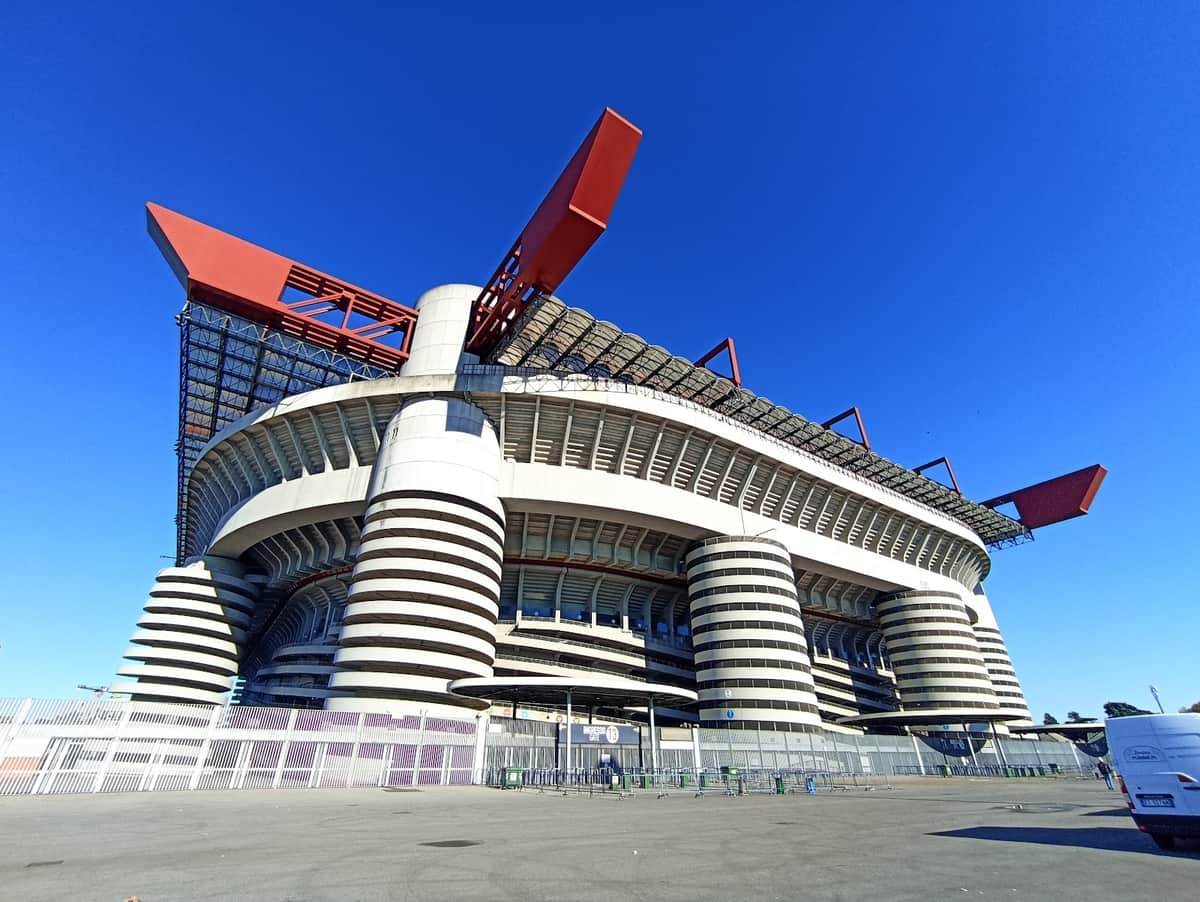 Photo: Gandalf 74 / Google MapsFootball
San Siro (Giuseppe Meazza)
Milan, Italy 75,817
San Siro (officially Stadio Giuseppe Meazza) is the shared home of Inter and AC Milan and holds about 75,800 — Italy's biggest stadium and one of football's great theatres. Seating is three stacked rings (primo, secondo, terzo anello), colour-coded by side: Rosso and Arancio are the two covered sideline stands, Verde is the north end and Blu the south. Inter's ultras fill the Curva Nord (second ring green), Milan's the Curva Sud (second ring blue) — the same concrete hosts opposite souls depending on who is 'home'. Best views: central primo or secondo anello Rosso/Arancio. It is also Italy's flagship concert stadium in summer.
Seating guide Photo: Omar Marcacci / Google MapsFootball
Santiago Bernabéu
Madrid, Spain 83,000
The renovated Santiago Bernabéu, home of Real Madrid, holds around 83,000 under a futuristic wrap-around skin with a retractable roof, a retractable pitch and a 360° videoboard ringing the bowl. The stadium is famously vertical: five-plus levels stacked steeply, so even upper seats feel on top of the play — but the top tiers are genuinely high. Best views are the central Lateral Este and Oeste (sideline) blocks on the lower and middle tiers; the Fondos (goal ends) are cheaper and house the animation section in the south. It sits on the Paseo de la Castellana with its own metro stop.
Seating guide Photo: Csaba Biro / Google MapsFootball
Selhurst Park
London, England 25,194
Selhurst Park is a four-stand ground built around noise. The two-tier Holmesdale Road Stand behind the south goal is the heartbeat: its lower tier houses the Holmesdale Fanatics ultras and is one of the loudest single areas in English football. Opposite behind the other goal, the small single-tier Whitehorse Lane Stand is the calm, family end. The two long sides are the Arthur Wait Stand (east) and the Leitch-era Main Stand (west) - both offer proper side-on views but both carry roof-support pillars and low roofs that cause restricted-view seats you should check before buying. Away fans get the northern end of the Arthur Wait Stand. Palace traditionally attack the Holmesdale end in the second half, so for a home goal surge sit in or near the Holmesdale lower. Best all-round sightlines are central Arthur Wait (blocks U-W) or the Holmesdale upper; best value tends to be the Whitehorse Lane family end or upper corners. A new, much larger Main Stand is under construction and will change the west side substantially over the coming seasons.
Seating guide Photo: Signal Iduna Park / Google MapsFootball
Signal Iduna Park
Dortmund, Germany 81,365
Signal Iduna Park (the Westfalenstadion), home of Borussia Dortmund, is Germany's biggest stadium at 81,365 for league matches — and home to the Yellow Wall (Südtribüne), Europe's largest standing terrace with almost 25,000 fans behind the south goal. The four stands (Nord, Ost, Süd, West) rise in two main tiers with filled corners. For pure viewing, central upper West or Ost blocks are best; for the experience, nothing in football matches standing on, or facing, the Yellow Wall. International matches convert standing to seats (~66,000).
Seating guide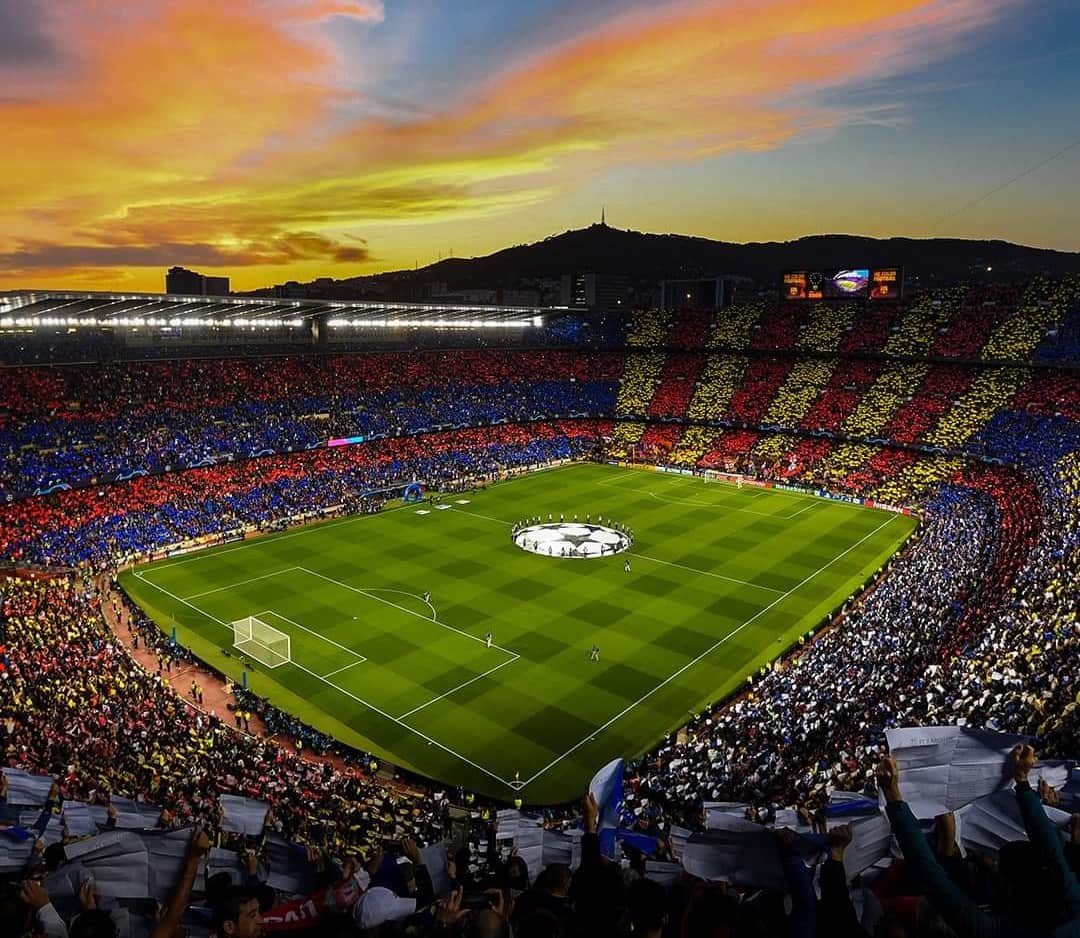 Photo: Md. Jarif Mahbub / Google MapsFootball
Spotify Camp Nou
Barcelona, Spain 105,000
Spotify Camp Nou, the home of FC Barcelona, is Europe's largest club stadium — around 105,000 when the current renovation fully completes. The bowl is three tiers: the covered Tribuna (main stand), the Lateral opposite, and the Gol Nord and Gol Sud behind the goals. The best sightlines are the central first and second tiers of the Tribuna and Lateral, roughly between the penalty areas; the third tier is dramatic but high and far. Barça returned to a partially reopened Camp Nou during the renovation, so some areas may be closed depending on the construction phase — always check the seat map at purchase.
Seating guide Photo: Christine / Google MapsFootball
St James' Park
Newcastle, England 52,264
St James' Park is the home of Newcastle United and one of England's largest football grounds, with a seated capacity of around 52,264. It is built around four stands: the towering, double-tiered Milburn Stand (west longside) and Leazes End (north), which are joined by filled-in corners and share one of Europe's largest cantilever roofs, plus the lower single-tier-plus-boxes Gallowgate End (south) and East Stand (east longside). The best all-round views are from the central East Stand and lower Milburn Stand along the touchline, while the loudest atmosphere sits in the Gallowgate End and the Strawberry Corner safe-standing area between the Gallowgate and East Stand. The best value is usually found in the shortside Gallowgate End and the lower Leazes End, whereas the upper Level 7 of the Milburn/Leazes complex is the cheapest but involves a long climb and a distant, high vantage. Away fans are housed high in the Leazes End at Level 7.
Seating guide Photo: Sven Süss / Google MapsFootball
Stade de France
Saint-Denis, France 80,698
The Stade de France holds around 80,000 and is the national stadium for both football and rugby, hosting France’s home internationals, the Coupe de France final, the Top 14 rugby final and major concerts. Its retractable lower tier converts the bowl from a close football/rugby configuration to an athletics arena with a track, as used at the 2024 Olympics. The stands are lettered around the ring, with the main sides holding premium seats and the ends behind the goals or posts generating the loudest support. The floating roof covers every seat, and central side seats give the best all-round view.
Seating guide Photo: Google MapsFootball
Stade Pierre-Mauroy
Villeneuve-d'Ascq (Lille), France 50,186
Stade Pierre-Mauroy (branded the Decathlon Arena) is a modern 50,000-seat two-tier bowl for LOSC Lille with a full retractable roof and a retractable half-pitch that turns it into an indoor arena. The four stands are named by compass point: Tribune Ouest and Tribune Est are the main side stands on the halfway line with the hospitality lounges, while Tribune Nord and Tribune Sud sit behind the goals. The Nord is the home kop — the Dogues Virage Est ultras (blocks D01-D04), plus groups like the Hardis Mastiffs and Go Lille 1, drive the noise and tifos there, and the Panorama Restaurant sits on its lower level. Away fans go in the south-east corner between the Sud goal-end and the Est side. Prices run from about €16 behind the goals to €90 on the halfway line, and sightlines are excellent throughout a compact-feeling bowl, the main caveats being the far reaches of the huge upper tier and a few upper corners near the roof structure. For concerts and arena events the roof closes and the north pitch retracts, with capacities from roughly 6,900 up to 50,000-plus (the Indochine show drew a record 67,838).
Seating guide Photo: Andrea Fantin / Google MapsFootball
Stadio Diego Armando Maradona
Naples, Italy 54,726
The Stadio Diego Armando Maradona, long known as the San Paolo, holds around 54,000 and is the fortress of SSC Napoli. The two ends behind the goals — Curva A and Curva B — are where the ultras and the loudest singing live, while the Distinti curve wrap round the corners and the Tribuna Posillipo and Tribuna Nisida form the covered main sides. An athletics track keeps every seat a little back from the pitch, and the best central views come from the upper Tribuna Posillipo. The ground was rededicated to Maradona days after his death in November 2020.
Seating guide Photo: Stadio Olimpico Tour / Google MapsFootball
Stadio Olimpico
Rome, Italy 70,634
The Stadio Olimpico holds around 70,000 and is shared by AS Roma and SS Lazio, who each take the home end when they play. The two curve behind the goals — Curva Sud for Roma, Curva Nord for Lazio — hold the ultras and the loudest support, while the long Tribuna Monte Mario is the covered main stand and Tribuna Tevere faces it. Best overall views are from the central Monte Mario; the running track pushes fans back from the action everywhere. Beyond football it hosts Italy’s rugby Six Nations matches, the Golden Gala athletics meeting and major concerts.
Seating guide Photo: Sanat Sawant / Google MapsFootball
Stamford Bridge
London, England 40,341
Stamford Bridge, the home of Chelsea FC in west London, is an intimate, four-sided all-seater stadium with a capacity of around 40,341 — the smallest of the Premier League's traditional "big six". The pitch is enclosed on every side by four covered stands: the two-tier Matthew Harding Stand (North), the three-tier East Stand, the three-tier West Stand, and the two-tier Shed End (South). The clearest, most balanced views are along the sides in the East and West Stands, while the loudest, best-value atmosphere is in the lower tier of the Matthew Harding Stand (around blocks L10–L14). Premium and hospitality seating is concentrated in the West Stand (Westview, Millennium, Drake and Bonetti suites) and parts of the East Stand. Away supporters are housed in the corner of the Shed End nearest the East Stand.
Seating guide Photo: Róbert dr. Zalatnai / Google MapsFootball
Strawberry Arena
Solna (Stockholm), Sweden 50,000
The Strawberry Arena is Sweden's national stadium and the largest in Scandinavia, seating 50,000 for football and up to 65,000 at concerts. Three main stands, Stand 1 through Stand 3, rise in tiers around the pitch, a retractable roof closes the bowl in around fifteen minutes, and a giant media cube hangs beneath it. It is home to AIK and the Swedish national team, and scales down to around 20,000 seats for intimate events.
Seating guide Photo: Murat Doğancı / Google MapsFootball
Şükrü Saracoğlu Stadium
Istanbul, Turkey 47,911
The Şükrü Saracoğlu Stadium is Fenerbahçe's famous home on the Asian side of Istanbul, seating 47,911 in four steep, double-tiered stands named the Maraton (west), Migros (north), Telsim (south) and the eastern stand, each roughly 10,000-14,000 seats. Each stand has its own membrane roof, the corners between them are open, and the absence of a running track puts every seat close to the pitch. It is renowned as one of the loudest grounds in European football.
Seating guidePhoto: Steve White / Google MapsFootballTottenham Hotspur Stadium
London, England 62,850
Tottenham Hotspur Stadium (opened 2019, capacity 62,850) is an asymmetric bowl built for more than football. Its defining feature is the single-tier South Stand — at 17,500 seats the largest single tier in the UK, a steep 34-degree 'wall' modelled on Dortmund's Yellow Wall and the loudest end of the ground. A world-first retractable synthetic pitch slides away to reveal an NFL/concert surface beneath, so the same bowl hosts Spurs, the NFL London Series, boxing and major concerts (Beyoncé, Bad Bunny, Lady Gaga). For football the best balanced views are the West and East lower tiers along the touchline; the upper tier (500s) is the best value with clean panoramic sightlines.
Seating guide Photo: Fatih Arslan / Google MapsFootball
Tüpraş Stadyumu
Istanbul, Turkey 42,684
Beşiktaş Park is a compact, ferociously loud arena where the crowd is almost on top of the pitch. The two long sides are the West (Batı) main stand — home to the VIP and 1903 hospitality and the best central sightlines — and the East (Doğu), the covered side that carries on the old 'Kapalı' tradition and is the best-value seat alongside the pitch. Behind the goals are the North (Kuzey / Yeni Açık) and South (Güney / Eski Açık, nearest the Bosphorus) ends, where the Çarşı-led hardcore support and the fiercest noise live; the North end is the one most often singled out as the loudest. Category 1 covers the lower West/East, Category 2 the upper West/East and Category 3 the ends, so budget fans behind the goals get the atmosphere for the lowest price. Away fans are boxed into an upper-tier corner. For European finals the stadium is renamed Beşiktaş Park and split neutrally; for concerts the pitch is floored for standing and a stage goes up at one end.
Seating guide Photo: Google MapsFootball
Veltins-Arena
Gelsenkirchen, Germany 62,271
The Veltins-Arena holds about 62,000 for Bundesliga matches, including a huge standing terrace, and is the fortress of FC Schalke 04. Schalke’s ultras and loudest support pack the Nordkurve behind one goal, a vast single-tier standing wall for domestic games. The Haupttribüne (main stand) on the west side holds the halfway line and premium seats, with the Gegentribüne opposite and the Südkurve at the other end. For international and European matches the standing areas convert to seats, reducing capacity to around 54,700. Best central views come from the Haupttribüne upper tier.
Seating guide Photo: Kyle Rowntree / Google MapsFootball
Villa Park
Birmingham, England 42,918
Villa Park, the home of Aston Villa in the Aston district of Birmingham, holds approximately 42,900 across four stands: the two-tiered Holte End behind the south goal, the three-tiered Trinity Road Stand along the west touchline, the two-tiered Doug Ellis Stand opposite on the east, and the two-tiered North Stand behind the north goal. The Holte End is the club's traditional home end and the loudest part of the ground, while the Trinity Road Stand offers the best elevated, side-on views and the bulk of the premium hospitality. For value, the North Stand and the upper reaches of the Holte End and Doug Ellis tend to be the cheaper areas, with central seats in the Trinity Road or Doug Ellis lower tiers giving the best all-round sightlines. For concerts (typically with the stage at the North Stand end), the pitch standing area closest to the stage offers the most immersive experience while the side stands provide seated, sheltered views.
Seating guide Photo: Google MapsFootball
Volksparkstadion
Hamburg, Germany 57,000
Volksparkstadion is a steep, roofed, football-only bowl where the home end is the Nordtribüne (North Stand) — HSV's ultras and the loudest standing terrace, strictly home-fans only. The long sides, the Osttribüne (East) and Westtribüne (West), hold the best all-round sightlines and the main hospitality; the West side houses the VIP and business lounges. The Südtribüne (South) is the second home end and shares its West-side corner with the away section. For Bundesliga and second-division matches the lower Nord terrace is standing (Stehplätze), giving 57,000; for UEFA/international games those rails convert to seats and capacity drops to about 51,500. For concerts an end-stage is built at the South end, the pitch becomes standing and seated floor blocks, and seats directly behind the stage in the South are sold restricted or not at all.
Seating guideAmerican Football (NFL)
30 venues Photo: eric / Google MapsNFL
Acrisure Stadium
Pittsburgh, USA 68,400
Acrisure Stadium seats 68,400 across four tiers: the Lower Level (100 sections), the Club Level (200 sections), a Suite Level and the Upper Level (500 sections), with luxury suites and thousands of club seats. The best sideline seats are the lower 100-level midfield sections 109 to 112 and 133 to 136, near the 50-yard line by sections 111 and 134; choose row M or higher to see over the benches. Atmosphere is loud and the open south end frames river-and-skyline views. It is open-air and can be cold and windy late season, and it has hosted the NHL Winter Classic, the Stadium Series and record concert crowds.
Seating guide Photo: Google MapsNFL
Allegiant Stadium
Las Vegas, USA 65,000
Allegiant Stadium is a 65,000-seat domed venue in Las Vegas (expandable to around 72,000 for major events) and home to the NFL's Las Vegas Raiders, with seating arranged across four tiers: the Lower Level (100s) ringing the field, a premium Loge/Club Level and 200 Level around the sideline mezzanine, and the Upper Level split into the 300s and 400s. The best overall seats are the lower-level sideline blocks between the 50-yard lines, roughly sections 128-134 (home) and the opposing sideline, while club seats (around C131-C137 and C109-C115) add lounge access. The best-value seats are the upper-level sideline 300 sections such as 321-338 on the west side, which keep full-field views at a fraction of lower-bowl prices. The most atmospheric area for Raiders games is the south end zone (sections 101-108), home to the Al Davis Memorial Torch and the legendary "Black Hole" fans. For concerts the layout switches to an end-stage bowl with a flat general-admission or seated floor plus the surrounding 100-400 level bowl.
Seating guide Photo: Yassine El Alaoui / Google MapsNFL
AT&T Stadium
Arlington, USA 80,000
AT&T Stadium, home of the Dallas Cowboys since 2009, is a retractable-roof, fully climate-controlled venue in Arlington, Texas with a standard seated capacity of approximately 80,000 (expandable to over 100,000 with standing room). Seating rises across four main bowls: the field-level Hall of Fame Level (100s), the Main Concourse / Main Club (200s), the Mezzanine Level (300s) and the Upper Concourse (400s), wrapped by 380-plus luxury suites and the famous centre-hung video board that keeps replays visible from almost every seat. The best seats are the lower sideline Hall of Fame sections around the halfway/50-yard line, while the upper-tier sideline 400s offer the strongest value with full views at a fraction of lower-bowl prices. Premium clubs such as the Hall of Fame Club and Main Club provide the most upscale experience along the sidelines.
Seating guide Photo: Victor Bubuioc / Google MapsNFL
Bank of America Stadium
Charlotte, USA 75,037
Bank of America Stadium seats 75,037 in a three-tier open-air bowl: the Lower Level (100 and 200 sections), the Club Level (300 level) and the Upper Level (500 level), plus luxury suites and members-only suite clubs. The best sideline seats are the lower 100-level midfield sections 106 to 117 and 126 to 137, with 113 to 127 between the 20-yard lines rated best for sightlines. The upper-deck sidelines 516 to 534 are the value pick, keeping good angles far cheaper thanks to the bowl's clean sightlines. It is open-air, so Charlotte heat is a factor early season and cool weather later, and it also hosts Charlotte FC and major concerts.
Seating guide Photo: Branden Jackson / Google MapsNFL
Caesars Superdome
New Orleans, USA 73,000
The Caesars Superdome seats around 73,000 for Saints games across a Plaza (lower) level, mid-level Loge and Club sections, and a Terrace (upper) level, all inside a fully enclosed, climate-controlled dome. Plaza-level sideline seats near midfield are the best overall, the clubs add indoor luxury, and the Terrace level is loud and great value. Because it is domed, every seat is weatherproof and the noise is intense. Beyond the Saints it hosts the Sugar Bowl, College Football Playoff, NCAA Final Fours and Super Bowls.
Seating guide Photo: Attila Boros / Google MapsNFL
Empower Field at Mile High
Denver, USA 76,125
Empower Field at Mile High seats 76,125 across a 100-level lower bowl, the 300-level United Club, a middle-level corner ring, the 200 and 400 suite levels and the 500-level upper deck. The best sideline seats are the lower 100-level sidelines, sections 102 to 108 and 120 to 126, and the United Club is the premium midfield ring. The open south end frames the skyline and mountains, and the 500-level south corner is the loudest part of the building. There is no roof, so high-altitude sun and late-season cold are real factors, with west-side sections shading first.
Seating guide Photo: Lindsey Herzig / Google MapsNFL
EverBank Stadium
Jacksonville, USA 67,814
EverBank Stadium seats 67,814 for football, expandable further, across a lower 100 level, a sideline club and middle 200 level and an upper 400 level, with no 300 tier. The best sideline seats sit in the lower 100 level between the 20-yard lines, with sections near the 50 prized, and the Gallagher club sideline seats offering cushioned mid-field views. Atmosphere centres on the north-end-zone pool deck and cabanas and the party zone in the south end. Being open-air in north Florida, expect heat, humidity and sun early season, with the ongoing renovation adding a shade canopy for most seats.
Seating guide Photo: Christopher Kensington / Google MapsNFL
Ford Field
Detroit, USA 65,000
Ford Field seats about 65,000 for football across a lower 100 level, a club 200 level and an upper 300 level, with the field sunk 45 feet below street level. The best sideline seats sit in the lower 100 level near the 50, specifically around sections 105 to 107 on one sideline and 126 to 128 on the other. As a climate-controlled indoor dome, weather is never a factor, comfortable in Michigan's cold winters, and its skylights keep the interior bright. Atmosphere is loud under the fixed roof, and it has hosted a Super Bowl, an NCAA Final Four, WrestleMania and major concerts.
Seating guide Photo: Alex Allison / Google MapsNFL
GEHA Field at Arrowhead Stadium
Kansas City, USA 76,416
GEHA Field at Arrowhead Stadium seats about 76,416 across a lower level (100s), a club level (200s) and an upper level (300s), all wrapped in the famous Sea of Red. The lower-bowl sidelines are the best overall seats, the club level adds indoor comfort, and the upper deck is loud, steep and great value. Its bowl shape makes it the loudest stadium in the world, a genuine home-field weapon for the Chiefs. Beyond football it hosts major concerts and international soccer.
Seating guide Photo: M Almrisi / Google MapsNFL
Gillette Stadium
Foxborough, USA 64,628
Gillette Stadium in Foxborough is the home of the NFL's New England Patriots and MLS side the New England Revolution, with a standard seated capacity of approximately 64,628 that can expand to around 70,000 for concerts and major events. Seating is arranged across three main tiers: the 100 Level (lower bowl), the 200 Level (largely premium club seating, branded the Cross Insurance Club, formerly the Putnam Club), and the 300 Level (upper deck). The best overall views come from the lower-bowl sideline sections around the 50-yard line (roughly sections 116-122), while the 200-Level club seats add heated indoor lounges that are a major comfort advantage in the cold New England autumn and winter. For best value, the upper-tier 300-Level sideline sections offer full field coverage at a fraction of the price. The stadium's signature 22-storey lighthouse stands at the north end and lights up to celebrate Patriots touchdowns.
Seating guide NFL
NFLHard Rock Stadium
Miami, USA 64,767
Hard Rock Stadium in Miami Gardens is a multi-purpose venue best known as home of the Miami Dolphins (NFL) and the Miami Hurricanes, and it also hosts the Miami Open tennis, the Formula 1 Miami Grand Prix and major concerts. The seating bowl is arranged over three main tiers — the Lower Level (100s), the Club Level (200s) and the Upper Level (300s) — all shaded by a part-open canopy added in 2016, plus executive suites and field-level premium clubs. For football, the best overall views are along the sidelines near the 50-yard line in the lower bowl (around sections 114-122 and 142-150), while the 200-level Club seats add air-conditioned lounge access; the most exclusive seats are the field-level 72 Club at midfield (sections 145 and 147). Best value is generally found in the upper-level sideline sections (around 313-323 and 341-352), which sit beneath the canopy and give a clean, elevated view at lower prices. End-zone (100s/300s) and corner sections are the cheapest seats but offer a flatter angle on the play.
Seating guide Photo: Kenneth Alberts / Google MapsNFL
Highmark Stadium
Orchard Park, USA 60,108
The new Highmark Stadium seats 60,108, the smallest fixed capacity in the NFL, in one continuous steep bowl arranged over 100, 200, 300 and 400 levels plus club and suite products. The official chart labels seats by zone, Sideline, Midfield, Corner and Endzone, on each level rather than by widely published section numbers. The best seats are the lower 100 level Midfield and Sideline zones, with the club products at midfield height. The bowl is engineered to be loud and close, with a canopy that traps crowd noise while leaving the pitch open to Buffalo's weather, and the venue is fully cashless.
Seating guide Photo: Kevin M / Google MapsNFL
Huntington Bank Field
Cleveland, USA 67,431
Huntington Bank Field seats 67,431 in four tiers: the Lower Level (100 sections), the Club Level and Mezzanine Level (both 300 sections) and the Upper Level (500 sections), with suites. The best sideline seats are the lower 100-level sidelines near midfield, while the raucous Dawg Pound fills the east end zone across the lower (118-122), mezzanine (317-323) and upper (537-546) levels. It is open-air and notoriously cold and windy off Lake Erie late season, and it hosts concerts, WWE and international soccer alongside Browns games.
Seating guide Photo: Mir Majid / Google MapsNFL
Lambeau Field
Green Bay, USA 81,441
Lambeau Field seats about 81,441 in a steep single-bowl design ringed by later upper-deck and end-zone additions, making almost every seat feel close to the field. The historic lower bowl (100-level) is backless bench, with 300 and 400 levels above and the 600/700 levels rising over the south end zone. The best sideline seats are in the lower bowl near midfield, but the end-zone corners deliver the loudest atmosphere and the famous Lambeau Leap. It is an open-air, cold-weather venue that also hosts summer concerts and NHL Winter Classic-style events.
Seating guide Photo: Erik Wilde / Google MapsNFL
Levi's Stadium
Santa Clara, USA 68,500
Levi's Stadium seats about 68,500 across a lower bowl (100s), two premium club/suite levels on the west sideline (200s and 300s), and an upper deck (400s). The best seats for comfort are on the shaded west side; the east-side lower bowl and the 400 level are notorious for brutal afternoon sun. Lower-bowl sideline seats near midfield are the best overall view, while the upper deck is the value play. The venue also hosts college football, major concerts, international soccer and hosted a Super Bowl.
Seating guide Photo: Joanne Cunningham / Google MapsNFL
Lincoln Financial Field
Philadelphia, USA 69,596
Lincoln Financial Field seats about 69,596 across a lower level (100s), a mezzanine/club level in the middle, and a steep upper level (200s). Lower-level sideline seats near midfield are the best overall, the club and suite tiers add comfort, and the notoriously loud 200 level offers value and atmosphere. It is an open-air stadium, so seats are largely exposed to Philadelphia weather. The venue also hosts Army-Navy games, college football, concerts and international soccer.
Seating guide Photo: Sean Keeley / Google MapsNFL
Lucas Oil Stadium
Indianapolis, USA 63,000
Lucas Oil Stadium seats about 63,000 for Colts games (expandable toward 67,000-70,000 for major events) across a lower level (100s), mid-level Loge/Club sections and an upper level (300s), under a retractable roof with a retractable north window. Lower-level sideline seats near midfield are the best overall, the clubs add indoor comfort, and the upper deck is loud and great value. With the roof, games can be open-air or fully climate-controlled. It also hosts NCAA Final Fours, the Big Ten Championship, concerts and hosted a Super Bowl.
Seating guide Photo: Evan Reed / Google MapsNFL
Lumen Field
Seattle, USA 68,740
Lumen Field is a steep, three-tier, partially roofed stadium in Seattle's SoDo district, home to the NFL's Seattle Seahawks and MLS's Seattle Sounders FC, and a host venue for the 2026 FIFA World Cup. Seating runs from the Field (100) Level lower bowl up through the Club/Mezzanine (200) Level — including the Wells Fargo Club and Delta Sky360 Club — to the Upper (300) Level, with the famous Hawks' Nest bleachers at the base of the north tower. The best overall seats are the lower-bowl sideline blocks near midfield/the 50-yard line (roughly sections 108-136), while the best value comes from the covered upper sideline 300-level and the lower-level corners. The cantilevered roof canopy shelters most sideline seats from Seattle's rain, but does not cover the field or the open end zones. For atmosphere, the lower end zones and the steep south upper deck are among the loudest seats in American sport.
Seating guide Photo: Tim Pruss / Google MapsNFL
M&T Bank Stadium
Baltimore, USA 70,745
M&T Bank Stadium seats 70,745 across five levels: the lower bowl (100s), the club level (200s), the 300 and 400 suite levels and the upper bowl (500s and 600s). The best sideline seats are the lower 100-level midfield sections 117 to 122 at the 50-yard line, with the prime sideline block running 110 to 130, while the club level offers oversized seats, eight full-service bars and lounges. The upper-deck sideline sections 518 to 528 are the best value, giving a full sideline view for far less. It is open-air, so expect cold, wind and occasional snow late season.
Seating guidePhoto: Alex Martin / Google MapsNFLMercedes-Benz Stadium
Atlanta, USA 71,000
Mercedes-Benz Stadium, opened in 2017 in downtown Atlanta, is a multi-purpose venue seating around 71,000 for NFL games (home of the Atlanta Falcons) and expandable to roughly 75,000 for major events. Seating is arranged across three main tiers: the 100 Level (lower bowl), the 200 Level (mezzanine, ringed with suites and club lounges) and the 300 Level (upper deck), all wrapped by the distinctive 360-degree "Halo Board" video ring beneath the retractable roof. The best overall views are along the lower-bowl sidelines around the 50-yard line (sections 107-113 on one side and 125-131 on the other, including club sections 108C-112C and 126C-130C), while the best value sits high on the 300 Level sidelines, which offer clean elevated views and the lowest prices. For Atlanta United matches the lower bowl can be curtained down to around 42,500, with the loudest atmosphere behind the goal in the supporters' sections (101-103 and 135-136). Premium options include the field-level Mercedes-Benz Club and Delta Sky360 Club in the lower bowl, the Harrah's Cherokee Club on the 200 Level, and numerous all-inclusive lounges and suites.
Seating guide Photo: Christian Zinner / Google MapsNFL
MetLife Stadium
East Rutherford, USA 82,500
MetLife Stadium, in East Rutherford, New Jersey, is the largest stadium in the NFL with a standard capacity of around 82,500, and shares its home between the New York Giants and New York Jets. The bowl is arranged in three main seating decks: the Lower Bowl (100 Level), the Mezzanine/Club Level (200 Level) and the Upper Bowl (300 Level), with luxury suites tucked between them. The best all-round views are from the sideline (long-side) sections near midfield on the 100 and 200 Levels, while the 200 Level Mezzanine Club adds cushioned seats and access to indoor climate-controlled lounges. For value, the 300 Level upper sideline blocks (roughly 312-315 and 338-341) deliver clear, elevated sightlines for the lowest prices. The stadium is open-air with no roof, so shade and weather exposure vary by section and time of day.
Seating guide Photo: John Stevenson / Google MapsNFL
Nissan Stadium
Nashville, USA 69,143
The current Nissan Stadium holds 69,143 across a Lower Level (100 sections), Club and Loge levels in the sideline towers (200 sections) and an Upper Level (300 sections), plus executive suites. The best sideline seats are the lower 100-level sidelines, sections 109 to 115 and 132 to 138 around midfield, while the upper east-sideline sections 314 to 328 add a Nashville skyline view. It is a loud, open-air venue exposed to sun and weather, popular for its riverside walk over from Broadway. A new enclosed Nissan Stadium with a translucent roof and around 60,000 seats is scheduled to open for the 2027 NFL season, after which the current stadium will be replaced.
Seating guide Photo: Google MapsNFL
Northwest Stadium
Landover, USA 64,000
Northwest Stadium seats about 64,000 in an oval of five tiers: the Lower Level (100 sections), the Club Level (300 sections), the Upper Level (400 sections) and two suite levels. The best sideline seats are the lower 100-level sidelines near midfield, while the Touchdown Club provides prime cushioned lower-level midfield seating with all-inclusive food and bar. Standing-room areas sit behind some of the 300s and 400s. It is open-air and exposed to weather, with the Metro a mile away, and it has hosted FIFA Women's World Cup matches, college football and major concerts.
Seating guide Photo: Julio Urena / Google MapsNFL
Paycor Stadium
Cincinnati, USA 65,515
Paycor Stadium holds 65,515 across three tiers: a lower 100 level, a club 200 level and an upper 300 level. The club 200 level sits between the decks with weather-protected, extra-padded seats, and the best sideline views come from the lower 100 level near the 50 (from around row 10 and up) and the first rows of the club 200 level. Atmosphere is loud and river-front, with the open corners framing the Ohio River and downtown skyline. It is open-air with cold, sometimes snowy late-season weather, and it hosts occasional college football and major concerts.
Seating guide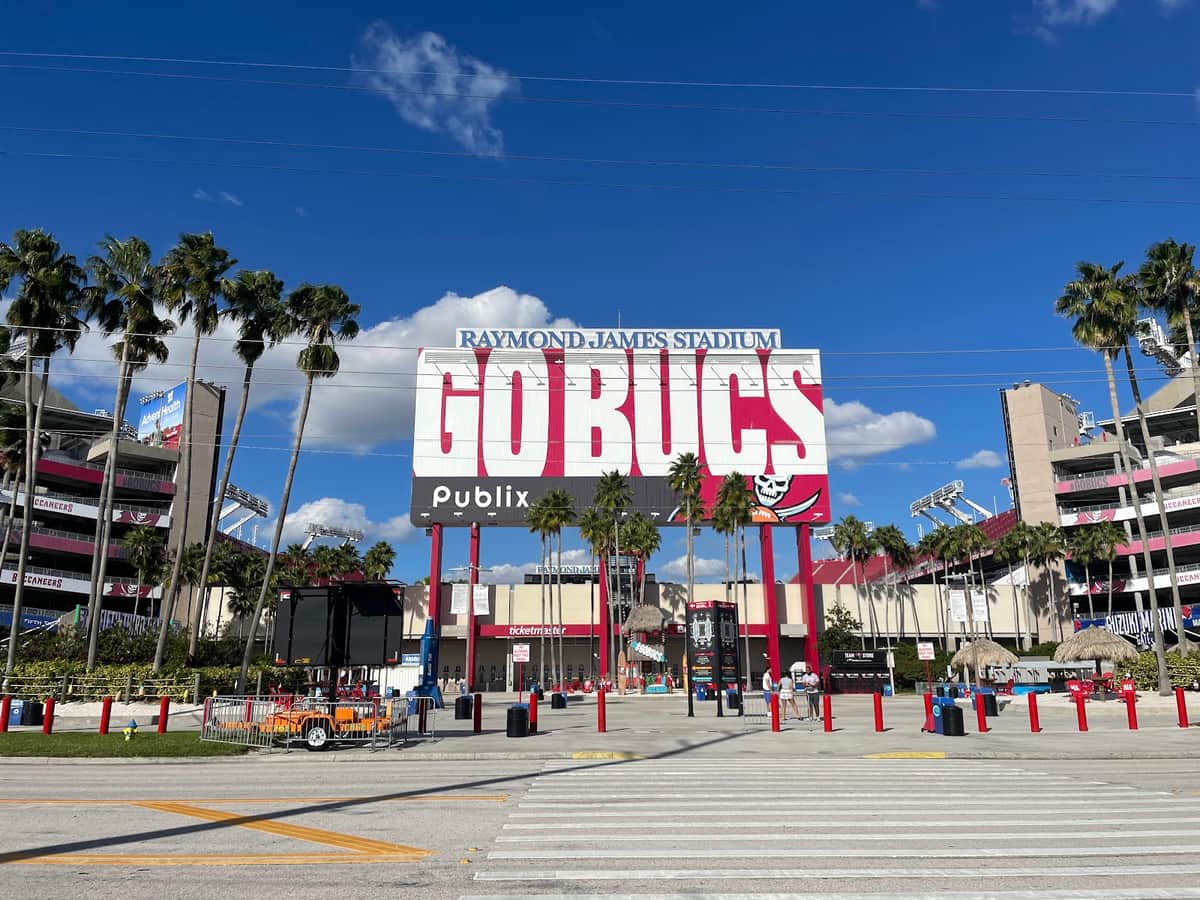 Photo: K G / Google MapsNFL
Raymond James Stadium
Tampa, USA 69,218
Raymond James Stadium seats roughly 69,000 across three tiers: the Lower Level (100 sections), the Club and Suite Level (200 sections) and the Upper Level (300 sections), plus executive suites. The best sideline seats are the lower 100-level sidelines around midfield, while the premium 200-level club seats are wider and cushioned. Atmosphere centres on Buccaneers Cove and the pirate ship in the north end zone, whose cannons boom after every score. As an open-air Florida venue it is hot and sun-exposed, with sudden rain a real factor, and it has hosted three Super Bowls and a College Football Playoff National Championship.
Seating guide Photo: Oscar Dominguez / Google MapsNFL
Reliant Stadium
Houston, USA 72,220
Reliant Stadium (long known as NRG Stadium) seats 72,220 for Texans games across four general tiers plus suites and premium clubs, under the first retractable fabric roof in the NFL. The lower 100 level wraps the field with premium sideline sections at midfield, the 300 level carries the club and mezzanine ring, and the 500 and 600 levels form the upper deck. The best sideline seats are the lower-bowl 50-yard-line sections 124 to 128. The roof is usually closed in Houston's heat, keeping crowd noise in and the interior climate-controlled. Beyond the Texans it hosts the Houston Livestock Show and Rodeo, the Texas Bowl, and hosted 2026 FIFA World Cup matches.
Seating guide Photo: Lupe Aguirre / Google MapsNFL
SoFi Stadium
Inglewood, USA 70,240
SoFi Stadium is the 70,240-seat home of the Los Angeles Rams and Los Angeles Chargers in Inglewood, expandable to roughly 100,000 for major events such as concerts, Super Bowls and Olympic ceremonies. Seating is arranged in a sunken bowl across the 100 Level (lower bowl), a SoFi Club / 200 Level mid-tier, a 300 Level mezzanine and the upper 400 and 500 Levels, all sheltered beneath a vast translucent ETFE canopy. The closest and most prestigious seats are the midfield 100 Level sidelines (around the 50-yard line), while the best value tends to be the corner and end-zone areas of the 100 and 300 Levels, where the wraparound Samsung Infinity Screen keeps even higher seats engaged. Premium options range from the Owner's, Google Cloud and SoFi Social clubs to field-level Premier sideline lounges and private suites. Because the canopy covers the whole seating bowl, almost every seat is shaded regardless of section.
Seating guidePhoto: PETER THOMPSON / Google MapsNFLSoldier Field
Chicago, USA 61,500
Soldier Field is the lakefront home of the NFL's Chicago Bears and the smallest stadium in the league, seating approximately 61,500 for football following its 2003 interior rebuild behind the preserved historic colonnades. Seating is arranged over four tiers: the 100 Level (lower bowl), the 200 Level (mid-tier, including the premium United Club on the east side), the 300 Level (upper bowl) and the steep 400 Level (Upper West) above the west sideline. The best overall views are from the lower sideline sections between the 20-yard lines (west 128-146, east 101-117), while the best value tends to be the 300 Level west sideline (330-344), which offers honest, head-on sightlines at a fraction of lower-bowl prices. For concerts staged at the north end, the south end zone sections facing the stage head-on (119-126) and premium field packages are the most sought-after, while the 400 Level Upper West gives some of the most distant views.
Seating guide Photo: Yassine El Alaoui / Google MapsNFL
State Farm Stadium
Glendale, USA 63,400
State Farm Stadium seats 63,400 for football, expandable further, across a lower Main 100 level, a club 200 level and an upper Terrace 400 level, plus a Ring of Honor row at the front of the terrace. The best sideline seats sit in the lower 100 level near the 50 (around sections 113 to 114 and the 106 to 124 band), with the Club 200 sideline offering premium mid-field views. Thanks to the retractable roof and air-conditioning, early-season desert heat is managed by playing with the roof closed, so shade and cooling, not cold, are the comfort consideration. Beyond the Cardinals it hosts the Fiesta Bowl, multiple Super Bowls and NCAA Final Fours.
Seating guide Photo: U.S. Bank Stadium / Google MapsNFL
U.S. Bank Stadium
Minneapolis, USA 66,655
U.S. Bank Stadium seats about 66,655 (expandable toward 70,000+ for events like the Super Bowl and Final Four) across a lower level (100s), a club level (200s) and a steep upper level (300s), all under a fixed translucent roof. Lower-level sideline seats near midfield are the best overall, the club level adds indoor comfort, and the upper deck is loud and great value. Because the roof is fixed, games are climate-protected year-round with natural light. It also hosts concerts, college basketball Final Fours, baseball and major events.
Seating guideCollege Football
14 venues Photo: Rawbee Wolfard / Google MapsCollege Football
Autzen Stadium
Eugene, USA 54,000
Autzen Stadium has been home to the Oregon Ducks since 1967. Its official seating capacity is 54,000, and standing room takes crowds past 60,000; the record is 60,129 against Ohio State in October 2024. Autzen Stadium seating is one continuous bowl of sections numbered 1 to 40: the Oregon sideline is on the open north side, and the taller south side, rebuilt in 2002, holds the Club at Autzen, the press level and the suites. On the Autzen Stadium seating chart, the best views are along either sideline between the 20-yard lines (about 8 to 14 on the north side and 28 to 34 on the south side), ideally 25 to 40 rows up. The south side's upper rows are the only covered seats, and the low, open end zones (1 to 3 and 38 to 40 at the west end, 19 to 23 at the east end) are the cheapest way into a sell-out.
Seating guide Photo: Tre De Lio / Google MapsCollege Football
Beaver Stadium
University Park, USA 106,304
Beaver Stadium is an open-air bowl whose sections are prefixed by compass point: N and S for the end zones, E and W for the sidelines. Lower sideline sections run WA to WJ and lower end zones NA to NL and SA to SK, while upper-level sections add a third letter (U for upper, C for club). The west side is the shade side and the east side the sunny one for afternoon games. The student section packs the south end lower level, the heart of the famous White Out; chairbacks exist only in the upper south end zone, and the rest of the bowl is bleacher.
Seating guide Photo: Jamie Epperson Suran / Google MapsCollege Football
Bryant-Denny Stadium
Tuscaloosa, USA 100,077
Bryant-Denny Stadium is a fully enclosed bowl with upper decks all the way around. Alabama standardised the numbering for the 2026 season: a lower bowl in sections 101 to 142 and an upper bowl in sections 801 to 859, with named club and zone areas at the ends, retiring the old letter scheme (A to N, U1 to U4). The west side is the Alabama home sideline and the shade side, while the east (visitor) side and the end zones take the most afternoon sun. The student section fills the south end; confirm the exact 2026 section numbers on the official chart.
Seating guide Photo: Jeremey Wald / Google MapsCollege Football
Camp Randall Stadium
Madison, USA 76,057
Camp Randall Stadium is an open-air horseshoe bowl that opens toward the south end. The lower bowl is lettered around the field (A to V, then into double letters AA, BB and on), with the Badgers sideline fronted by roughly sections D to F on the west and the visitor sideline by S to U on the east; a west-side upper deck rises over the lower bowl. It is a mostly sun-exposed bowl with limited shade, so the upper rows under the overhang stay coolest for afternoon kickoffs. The student sections fill the south end and the lower J to P sections, home of the 'Jump Around' that erupts between the third and fourth quarters. Confirm exact section numbers on the official chart.
Seating guide Photo: Anna Banana / Google MapsCollege Football
Carter-Finley Stadium
Raleigh, USA 56,919
Carter-Finley Stadium, home of NC State Wolfpack football since 1966, has a seating capacity of 56,919. The Carter-Finley Stadium seating chart is a closed bowl: sideline sections have one- and two-digit numbers, with the lower sidelines at 1 to 8 (east, visitors' side) and 17 to 24 (west, NC State side) and the upper decks at 9 to 15 (east) and 25 to 31 (west), while the end zones use three-digit numbers, 110 to 127 in the lower end zones, 210 to 227 behind them and 319 to 326 in the upper north end under the video board. TowneBank Center rises above the west stands with suites, the Dail Club and the Wolves Den. For the best Carter-Finley Stadium seating, look at the lower west sideline near NC State's bench (around 19 to 22) and the matching midfield sections on the east side (around 4 and 5). Students fill the lower end zones and sections 6 to 8, and visiting fans are usually seated in sections 1, 9, 15, 25 and 31. For the 2026 season NC State changed the seat numbers on all bleacher seats, so check your ticket against the new numbering.
Seating guide Photo: Bhuvanesh arulraj / Google MapsCollege Football
Darrell K Royal-Texas Memorial Stadium
Austin, USA 100,119
DKR is an open-air bowl, closed by the 2021 south end zone. It has two tiers: a lower level with low, two-digit sections (the Texas bench sideline around 3 to 6, the visitor sideline around 27 to 30, plus ends and corners) and a 100-level upper deck. The west sideline (sections 1 to 8 and 101 to 109) is the shade side, which matters in the Texas heat, while the east side (25 to 32 and 124 to 132) bakes at kickoff. Student seating concentrates on the east side and south-east corner under Godzillatron. The best sideline seats are the lower west midfield (3 to 5); confirm exact numbers on the official chart.
Seating guide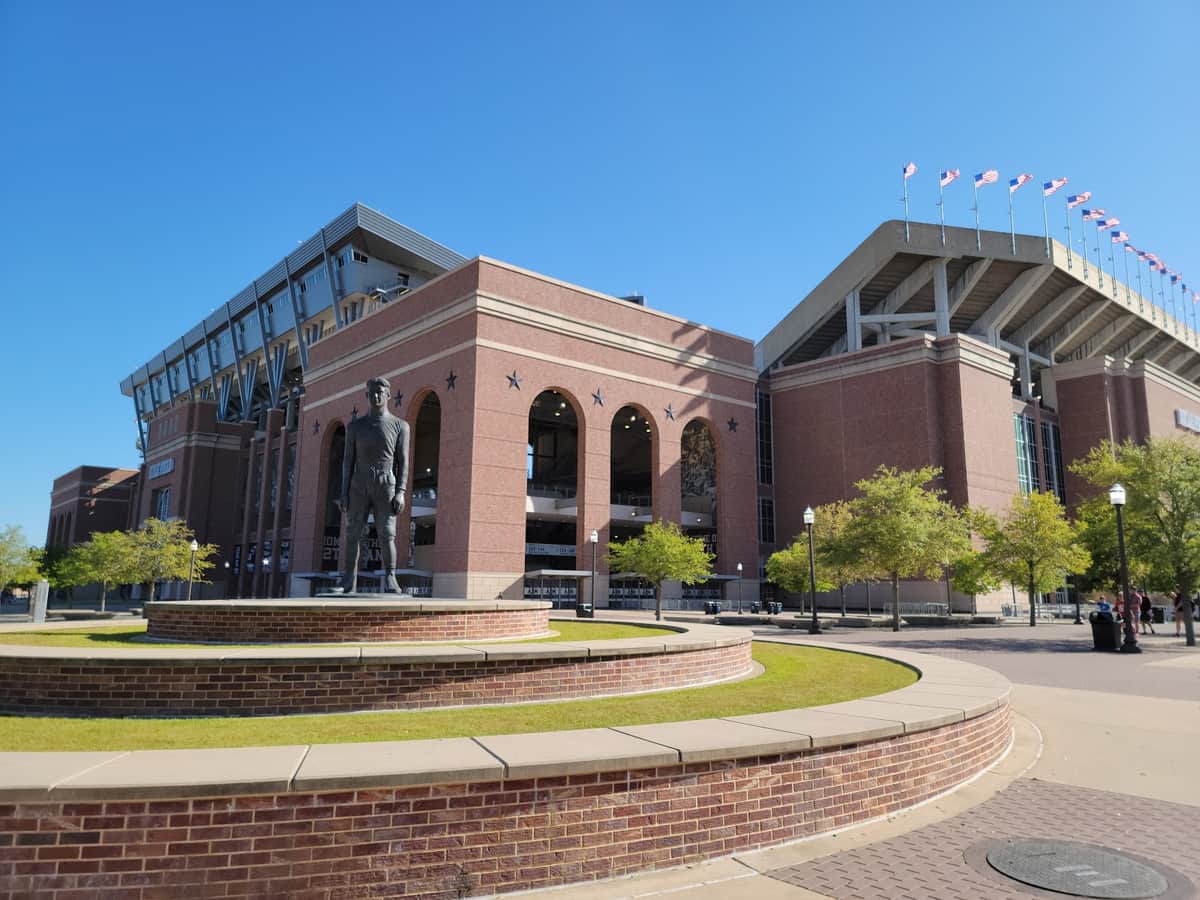 Photo: Mike Oropeza / Google MapsCollege Football
Kyle Field
College Station, USA 102,733
Kyle Field is a three-deck bowl: a lower level, a middle level, an upper level and a top upper deck on the sidelines. Per the official numbering, one sideline runs sections 101-135 (lower), 201-235 (middle), 301-335 (upper) and 401-435 (upper deck); the opposite runs 501-535 / 601-635 / 701-735 / 801-835. The west sideline is the A&M home side and the shade side, with the sun setting behind it, while the east sideline bakes in afternoon sun and holds the standing 12th Man student section. Best sideline seats are the lower 100-level around midfield. There is no dedicated away-fan block.
Seating guide Photo: Michigan Stadium ”Big house ” / Google MapsCollege Football
Michigan Stadium
Ann Arbor, USA 107,601
Michigan Stadium is a single continuous below-ground bowl, numbered in sections 1 to 44 around the field with premium 300 and 400 club levels above the sidelines. The west sideline (roughly sections 20 to 26) is the Michigan bench side and the shade side, tucked under the press box, while the east sideline (1 to 4 and 42 to 44) is the visitor side and takes the afternoon sun. The student section fills the south end, with visiting fans in the upper south end zone. Because it is one deep bowl the best sideline seats sit at midfield and the top rows feel like an upper deck; most seating is backless aluminium bench, with chairbacks only in the west premium area.
Seating guide Photo: Brent Ellis / Google MapsCollege Football
Neyland Stadium
Knoxville, USA 101,915
Neyland Stadium is an enclosed bowl whose lower level is lettered A to W around the field (the Tennessee benches in front of sections S to V) and whose upper level uses double letters (AA to ZZ). The west side falls into shade first, while the east side stays sunlit longest, which flips from a drawback in September to a warm bonus in November. The student sections are D to K on the lower level, with bench seating; the north end Social Deck is standing-room general admission. The best sideline seats are the lower west (roughly P to W) between the 20s; confirm exact numbers on the official chart.
Seating guide Photo: Drone Hero Inbox / Google MapsCollege Football
Ohio Stadium
Columbus, USA 102,780
Ohio Stadium stacks into three overhanging decks: the A deck (lower), the B deck (mid, mostly chairbacks and largely covered by the overhang except the end-zone B sections) and the C deck (upper), labelled by number plus deck letter. Lower-sideline centre seats sit in roughly 11-16A and 25-30A, and the covered, chairbacked B deck is the comfort pick. The west sideline is the shade side and the east sideline the sunny one, with extra cover under the C-deck overhangs and across the closed north end. The student sections fill the south end zone (31-39) plus Sections 1-7, with the famous Block O in 39A and 1A-2A. There is no dedicated away-fan block.
Seating guide Photo: Pictureframe Usa / Google MapsCollege Football
Rose Bowl Stadium
Pasadena, USA 89,702
The Rose Bowl is the historic open-air stadium in Pasadena that hosts UCLA Bruins football and the annual Rose Bowl Game, plus major concerts and international football. The Rose Bowl seating capacity is 89,702, and the building once held far more (104,091 at its peak, with a record crowd of 106,869 in 1973). The Rose Bowl seating chart is simple: one continuous oval bowl split into 28 numbered sections, with the tunnels carrying the same numbers. Sections 1 to 8 line the east side, 9 to 14 the north end, 15 to 22 the west side and 23 to 28 the south end. Each section has 77 numbered rows with lettered rows below Row 1, and you enter from the tunnel at Row 28. The west sideline (sections 16 to 21) is the UCLA bench side and sits under the Terry Donahue Pavilion, home of the suites, loge boxes and club seats. The east sideline (sections 2 to 7) faces it, and at UCLA games it holds The Den student section. There is no roof or upper tier, so every seat is out in the open.
Seating guide Photo: Patricia Alane / Google MapsCollege Football
Sanford Stadium
Athens, USA 92,746
Sanford Stadium is famous for the privet hedges that ring the field, the origin of the 'between the hedges' nickname. The sidelines carry a lower 100 level, a 200-level club ring around most of the bowl, an upper 300 level and a 600-level deck on the north sideline, and the end zones are decked. The south side, below the press box, is the home side and the shade side, while the north side and the end zones stay sunny. The best sideline seats are the lower 100-level midfield on the south side; confirm exact section numbers on the official UGA map.
Seating guide Photo: Akshat Goel / Google MapsCollege Football
Stanford Stadium
Stanford, USA 50,424
Stanford Stadium is the home of Stanford Cardinal football, a 50,424 seat open air bowl on the Stanford University campus that was rebuilt in 2006 inside the footprint of the 1921 original. The Stanford Stadium seating chart has two levels that wrap all the way round: the Lower Level (sections 101 to 140) and the Upper Level (sections 201 to 240), with a Skybox on one sideline for the Director's Level seats and suites. The 50 yard line is at sections 113 and 213 on the Stanford side and 133 and 233 on the visitor (east) side, and the Buck/Cardinal Club chairback seats cluster around those midfield sections. From 2025 the Red Zone student section runs from section 136 on the east sideline round into the south end zone as far as section 104. Every seat has a back, and all seating is uncovered by a roof, so dress for the weather.
Seating guide Photo: B C / Google MapsCollege Football
Tiger Stadium
Baton Rouge, USA 102,321
Tiger Stadium is a century-old enclosed bowl. The lower bowl runs in the 100s and 300s (the 100s along the west, LSU-bench sideline and the 300s along the east, visitor sideline), with upper decks in the 500s and a double-decked south end in the 600s. LSU is famous for night games, so heat, humidity and noise matter far more than sun angle; for a rare day game the west side shades sooner. The student block sits in the north and north-west 200s, with the Golden Band from Tigerland in section 217. The best sideline seats are the lower-100 midfield on the west side; check the official chart for exact section numbers.
Seating guideRugby
5 venues Photo: Twickenham Stadium / Google MapsRugby
Allianz Stadium Twickenham
London, England 82,000
Twickenham holds around 82,000 in a three-tier bowl wrapped on all four sides, the home of English rugby. The best views sit along the halfway line in the middle or upper tiers, the loudest atmosphere is in the lower tier behind the posts, and the upper corners are the best value. Much of the middle tier is debenture and hospitality seating. It hosts England internationals including the Six Nations and autumn Tests, plus the Premiership final and major concerts.
Seating guide Photo: Vasile Craciun / Google MapsRugby
Aviva Stadium
Dublin, Ireland 51,700
Aviva Stadium holds around 51,700 in a curved, continuous bowl that is three tiers high on the South, East and West sides and a single low tier at the North end. The best views run along the halfway line in the upper or premium tier, the lower tier behind the posts is best for atmosphere and try-line action, and the upper South Stand and corners are the best value. It is the home of Irish rugby and football, and also stages Leinster's biggest European nights and major concerts.
Seating guide Photo: Eden Park / Google MapsRugby
Eden Park
Auckland, New Zealand 50,000
Eden Park is New Zealand's national stadium: roughly 50,000 seats for rugby and football, up to 60,000 for the biggest tests with temporary seating, and about 42,000 in cricket configuration. It sits in Kingsland, 3km from the Auckland CBD, and it is home to the Blues, Auckland Rugby and Auckland Cricket, as well as being the All Blacks' fortress. The ground is deliberately asymmetric after the 2008 to 2010 redevelopment. The Samsung South Stand is the big three tier structure that holds around 24,000 on its own, the University of Auckland North Stand faces it, and the three tier East Stand replaced the old terraces, with the lower West side completing the ring. Bay numbering follows the stands rather than one continuous ring: the lower bowl is 301 to 337 and covers the east, south and west only, because the north carries retractable seating at that level. Above it, 401 to 415 sit over the north stand and 416 to 434 over the south, 501 to 515 form the north upper tier, and 629 to 644 are the outermost bays on the south. On the east, 307 to 315 sit closest to the field with 301 to 306 behind them on the Cricket Ave side. The accessible Permobil Comfort Zones are at 319 and 323 in the South Stand. For rugby the halfway line seats in the South and North stands are the best in the house, the middle tier of the South Stand being the pick; for cricket the ground plays as an oval and the East and West sides give you the square boundary view. Roughly 38,000 of the seats are under cover, which in Auckland is not a detail to skip over.
Seating guide Photo: Winson Lee / Google MapsRugby
Principality Stadium
Cardiff, Wales 73,931
The Principality Stadium holds around 74,000 in three steep tiers close to the pitch, the home of Welsh rugby. The best views run along the halfway line in the middle tier, the loudest support is in the lower tier behind the posts, and the upper corners are the best value. Its retractable roof, often closed for internationals, traps and amplifies the noise. It hosts Wales Test matches including the Six Nations, plus football finals, concerts and other events.
Seating guide Photo: Google MapsRugby
Suncorp Stadium
Brisbane, Australia 52,500
Suncorp Stadium, still Lang Park to locals and "the Cauldron" on State of Origin night, is a 52,500-seat rectangular stadium in Milton about 2km west of the Brisbane CBD. The 2003 rebuild wrapped three tiers tight around the pitch with no running track between the seats and the touchline, which is why it has a reputation as one of the best rectangular grounds in the world to watch football codes in. The bowl is a continuous ring. The Western Grandstand holds the tunnels, benches, media and the corporate suites; the Eastern side faces it across the halfway line; and the two ends sit behind the tryline, the southern end at Milton Road (Gates A and B) and the northern end at Caxton Street (Gates C, D and E). Bay numbering climbs with height: the lower ring is 301 to 340 and runs the whole way around, the middle ring is 506 to 536 across the northern, eastern and southern sides, and the upper ring is 704 to 738, except above the Western Grandstand where it is 601 to 604 and 638 to 640. The Western Grandstand is the one side with no middle tier. For rugby league, rugby union and football the halfway sections on either sideline are the premium view and the tryline ends are the cheapest and the loudest. For concerts the pitch is floored with the stage at one end, which turns the far end and the sections beside the stage into the seats to think twice about.
Seating guideMulti-sport & Olympic
6 venues Photo: Accor Stadium / Google MapsMulti-sport
Accor Stadium
Sydney, Australia 83,500
Accor Stadium (Stadium Australia, Sydney Olympic Park) holds around 83,500 for rugby league and hosts the NRL Grand Final and NSW State of Origin, plus rugby union, soccer, cricket, AFL and concerts. Retractable end stands convert between rectangular and oval modes. Halfway-line sideline seats (east/west) give the best balanced view; upper-tier sidelines are the best value.
Seating guide Photo: Taylor Wimberly / Google MapsMulti-sport
Alamodome
San Antonio, USA 62,834
The Alamodome seating capacity is 62,834 for football and soccer, according to the venue's official configuration maps, rising to 71,296 for a full-stadium show in the round and 56,016 for a concert with the stage at the south end. It is home to UTSA Roadrunners football and the Valero Alamo Bowl. The Alamodome seating chart has three seating levels: the Plaza Level lower bowl (sections 101 to 144), the Club Level (201 to 244) and the Upper Level (301 to 348). For football the best seats are Plaza Level sidelines either side of the 50-yard line (sections 134 on the west side and 112 on the east side), and the best value is the Upper Level sideline around 337 and 313. The Alamodome seat map is set out as a rectangle, so sideline seats run parallel to the field and end-zone seats look straight down it, and the roof means no seat is exposed to the Texas sun or rain.
Seating guide Photo: Kazuk Hiros / Google MapsMulti-sport
Japan National Stadium
Tokyo, Japan 68,000
The Japan National Stadium seats around 68,000 (nearer 60,000 for pitch sports with the athletics track present) in three tiers under Kengo Kuma's timber-eaved roof. The best all-round views are along the main side at halfway, the upper tier is sheltered by the eaves and the best value, and the home straight is best for athletics finishes. The running track sets spectators back from a football or rugby pitch. Built for Tokyo 2020, it hosts athletics, football and rugby internationals, finals and major concerts.
Seating guide Photo: Google MapsMulti-sport
Marvel Stadium
Melbourne, Australia 56,347
Marvel Stadium (Docklands) holds 56,347 and was the first Australian stadium with a fully retractable roof. Seating is three levels (1–3) across sections 1–48 with two named ends, Lockett and Coventry. Fans rate the Level 3 wings best for AFL; the Level 2 Medallion Club centre-wing is the premium pick.
Seating guide Photo: Peifeng / Google MapsMulti-sport
Singapore National Stadium
Singapore, Singapore 55,000
The Singapore National Stadium seats around 55,000 under the world's largest free-standing dome, with a retractable roof and movable lower tier that reshape the bowl for different sports. The best all-round views run along the main side at halfway, the upper tier is always under the dome and the best value, and lower-tier blocks are closest for concerts and rugby sevens. Every seat has an individual cooling vent. It hosts football and rugby internationals, the HSBC Singapore Rugby Sevens, cricket, athletics and major concerts.
Seating guidePhoto: NoUser / Google MapsMulti-sportWembley Stadium
London, England 90,000
Wembley Stadium is England's 90,000-seat national stadium and the second-largest in Europe — home to England internationals, the FA Cup final, NFL London games, and some of the world's biggest concerts. The bowl is a three-tier design: the lower tier (blocks 101–144), the middle Club Wembley tier (blocks 201–252, all premium hospitality) and the upper tier (blocks 501–552). Blocks are numbered clockwise from the halfway line. The best general views are the lower-tier long sides at the halfway line; Club Wembley offers the best comfort and sightlines; the upper tier is the best value with panoramic views.
Seating guideBaseball
18 venues Photo: Francisco Rodriguez / Google MapsBaseball
Angel Stadium
Anaheim, USA 45,517
Angel Stadium in Anaheim, often searched as Angels Stadium, has been home to the Los Angeles Angels since 1966 and seats 45,517 for baseball. The Angel Stadium seating chart has four main levels: the Field Level (sections 101 to 135), the Terrace Level (201 to 233, plus outfield sections 236 to 260), the Club Level (301 to 351) and the View Level, split into the 400s and 500s. On every level the numbers rise from the left-field side to the right-field side, with home plate in the middle (around 117 to 119 on the Field Level). The best views are in the Field Level infield, with the Lexus Diamond Club seats behind home plate; the Angels dugout is on the third-base side. For value and shade, the Terrace Level infield sits under the overhang, and the View Level behind home plate is the cheapest full view of the field.
Seating guide Photo: jeffery heil / Google MapsBaseball
Busch Stadium
St. Louis, USA 44,383
Busch Stadium is the downtown ballpark of the St. Louis Cardinals, with a seating capacity of 44,383. The Busch Stadium seating map has four seating levels: the Field Level (100s), the Loge and Redbird Club level (200s), the Pavilion level (300s) and the Terrace level (400s). Home plate sits in the south west corner of the ballpark, with the Cardinals dugout on the first base side and the visitors' dugout on the third base side. The seats closest to the plate are the CommunityAmerica Cardinals Club (field sections 1 to 8) and the Cardinals Infield and Home Boxes (141 to 148). Along the lines, the Cardinals Dugout Box and 1st Base Field Box (135 to 140) face the Visitors Infield Box and 3rd Base Field Box (156 to 165). The outfield has bleachers in right field (101 to 111) and left centre (189 to 197), plus the social Budweiser Terrace in right field, open to every ticket holder with no assigned seats. Busch Stadium seats are all open-air, and from behind home plate you look out across the outfield towards downtown and the Gateway Arch.
Seating guide Photo: Randolfo Santos · / Google MapsBaseball
Chase Field
Phoenix, USA 48,330
Chase Field is the downtown Phoenix home of the Arizona Diamondbacks, a retractable-roof, air-conditioned ballpark that the D-backs' 2024 media guide lists at 48,330 seats. The Chase Field seating chart has four levels: lettered Field Level sections (A to S) closest to the field, the 100 Level lower bowl and outfield bleachers (101 to 144), the Diamond Level club seats and suites (200 to 223) and the 300 Level upper deck (300 to 332). Because around 80 per cent of the seats are in foul territory and the suites are tucked under the third deck, the upper deck is one of the highest in the majors. The best seats on the Chase Field seating map are the Field Level boxes between the dugouts and the 100 Level infield (113 to 131); the best value is the MVP Box, the first seven rows of upper-deck infield sections 310 to 322. With the roof and air conditioning, shade matters less than at open ballparks, although the right-field bleachers take the most sun when the roof is open.
Seating guide Photo: Arun / Google MapsBaseball
Citi Field
New York, USA 41,922
Citi Field seats about 41,922 across the Field level (100s), club and premium levels including the Excelsior level (300s), and the upper Promenade level (500s). Lower-level seats around the infield are the best overall, the outfield seats are the spot for home runs and the Home Run Apple, and the Promenade offers value with skyline views. As an open-air park, sun and shade shift by game time, with the third-base side generally finding shade earlier for day games. It also hosts concerts and international soccer.
Seating guide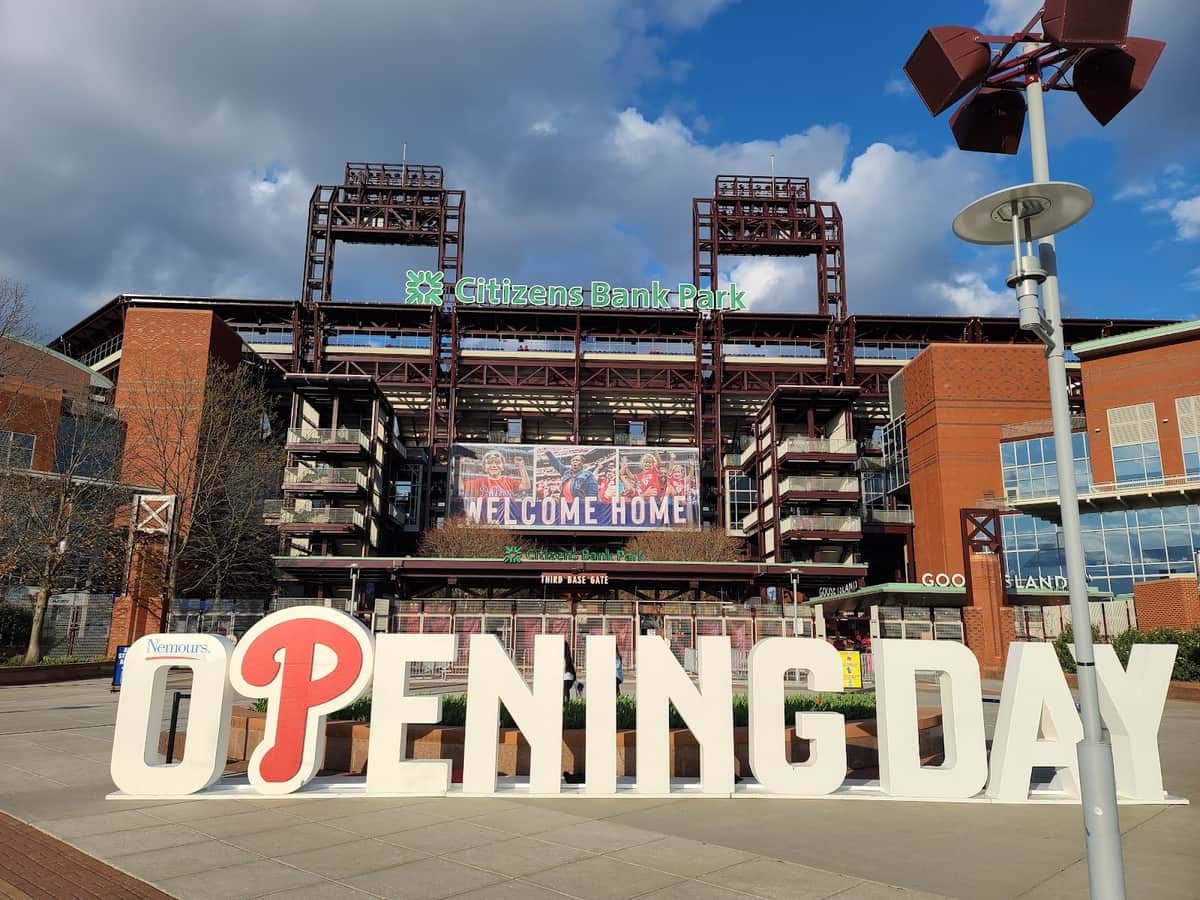 Photo: Samual Sproat / Google MapsBaseball
Citizens Bank Park
Philadelphia, USA 42,901
Citizens Bank Park is the home of the Philadelphia Phillies, with an official seating capacity of 42,901. Citizens Bank Park seating is spread over three main levels: the Field Level (sections 101 to 148) with the Philadelphia Insurance Club behind home plate, a middle level made up of the Pavilion (201 to 211) in right field, the Cadillac Hall of Fame Club (212 to 232) round the infield, the Arcade (233 to 237) and the Scoreboard Porch (241 to 245) in left field, and the Terrace Level, with the Pavilion Deck (301 to 310), the Terrace (312 to 333) and the Terrace Deck (412 to 434). Suites sit directly above the Field Level. The best seats for a Phillies game are the Field Level infield sections between the dugouts, and the Terrace infield is the best value. All seats are angled towards the infield.
Seating guide Photo: Brandon Williams / Google MapsBaseball
Comerica Park
Detroit, USA 40,988
Comerica Park, home of the Detroit Tigers since 2000, holds 40,988 for baseball (MLB.com, as of 2024) and will be renamed Fifth Third Park from the 2027 season. The seating map of Comerica Park has three main areas: the Lower Level (sections 101 to 151), a lower upper deck down the first base and right field side (sections 210 to 219), and the main Upper Level (sections 321 to 345) from first base round behind home plate to left field. There is no upper deck in the outfield, which keeps the downtown skyline in view. The Tigers dugout is on the third base side and the visitors dugout on the first base side, with both bullpens in left field. Premium options run from the new Home Plate Club and On-Deck Circle seats at field level to the Tiger Den, the Champions Club and the MotorCity Casino Hotel Tiger Club.
Seating guide Photo: Captain Colorado Photography / Google MapsBaseball
Coors Field
Denver, USA 46,891
Coors Field in downtown Denver has been home to the Colorado Rockies since 1995 and seats 46,891, or 50,144 with standing room. The Coors Field seat map has a Field Level of box seats (sections 105 to 150) with the Pavilion (151 to 160) and the Rockpile bleachers (401 to 403) in the outfield, a 200 Level with the Right Field Mezzanine (201 to 209) and the Club Level (214 to 247), and a 300 Level upper deck (301 to 347), topped in right field by The Rooftop. The best seats are the Infield Box sections behind home plate and the dugouts (about 120 to 141), with the Rockies dugout on the first-base side. The Club Level infield is the best-value premium view, and the Rockpile in centre field is famously the cheapest ticket in the ballpark. Look out for the row of purple seats in the upper deck, exactly one mile above sea level.
Seating guide Photo: LJ V / Google MapsBaseball
Dodger Stadium
Los Angeles, USA 56,000
Dodger Stadium, the home of the Los Angeles Dodgers since 1962, is the largest ballpark in Major League Baseball by listed capacity, at approximately 56,000 seats held flat by a long-standing conditional-use permit. Its tiered bowl rises through four main seated levels — Field, Loge, Reserve and Top Deck — wrapped around the diamond, with the lively outfield Pavilion behind the fences. The best overall views are from the Field level around home plate and the infield, while the Loge level is widely considered the best value, pairing strong, elevated sightlines with mid-range pricing. Budget seats sit in the upper Reserve and Top Deck, which deliver sweeping San Gabriel Mountain and skyline views in exchange for distance from the play. For day games, seats under the upper-deck overhangs and on the third-base side tend to hold shade longest.
Seating guide Photo: Google MapsBaseball
Fenway Park
Boston, USA 37,755
Opened in 1912, Fenway Park is the oldest ballpark in Major League Baseball and home of the Boston Red Sox, with a standard seated capacity of approximately 37,755 for night games (around 37,105 for day games, when the centre-field seats in Section 35 are tarped over). The lower bowl runs from the field-level Dugout and Field Boxes up through the Loge Boxes and the covered, wooden Grandstand, while the upper deck holds the State Street Pavilion and the premium Dell Technologies (formerly EMC) Club; the famous Green Monster seats sit atop the 37-foot left-field wall, and the Bleachers fill centre and right field. For the best overall views, target Field Boxes from dugout to dugout in the infield; for value, the assigned, pole-free Bleachers and the upper Pavilion offer good sightlines for less. Because Fenway is so old, several Grandstand seats are partially obstructed by the steel poles that support the upper level, so it pays to check the exact section and row before booking.
Seating guide Photo: 임서윤 / Google MapsBaseball
Oracle Park
San Francisco, USA 41,915
Oracle Park seats about 41,915 across the Field/Lower level (100s), the Club level (200s), the View level (upper, 300s), plus the left-field Bleachers and the right-field Arcade above McCovey Cove. Lower-level seats around the infield are the best overall, the Arcade and bleachers are the spots for splash-hit home runs, and the View level is great value with sweeping bay views. As an open-air bayfront park it is often cold and windy, so layers matter and the sunny side varies by game time. It also hosts concerts and college football.
Seating guide Photo: M / Google MapsBaseball
Oriole Park at Camden Yards
Baltimore, USA 44,970
Oriole Park at Camden Yards seats about 44,970 across Lower Box/field seats, the Club level (200s), and the Upper Deck (300s), plus the Eutaw Street promenade and Flag Court in right field. Lower-level infield boxes are the best overall, the right-field areas near the warehouse are the spot for home runs, and the upper deck offers value with warehouse and skyline views. As an open-air park, sun and shade shift by game time, and the club overhang and third-base side offer more relief. It also hosts occasional concerts and events.
Seating guide Photo: Angela X / Google MapsBaseball
Petco Park
San Diego, USA 39,860
Petco Park is the downtown home of the San Diego Padres, with a seating capacity of 39,860. The Petco Park seating chart has three main levels: the Field Level (sections 101 to 137), the Terrace Level (201 to 235) and the Upper Level (300 to 329). Odd numbered sections run up the first base line towards right field and even numbers up the third base line towards left field, starting from 101 and 102 behind home plate. Premium seating wraps home plate, from the Blue Shield Home Plate Club at the front to the Lexus Club (lettered sections A to L) behind it. The Padres dugout is on the first base side and the visitors' dugout on the third base side. In left field the Western Metal Supply Co. building holds rooftop and rail seating above the foul pole, while right field has the lower boxes (129 to 137) and the Right Field Upper sections (227 to 235). The official Padres shade map shows the third base side, especially the back rows, getting the most shade and the first base side the most sun. Beyond the outfield, Gallagher Square hosts its own concerts on the Sycuan Stage.
Seating guide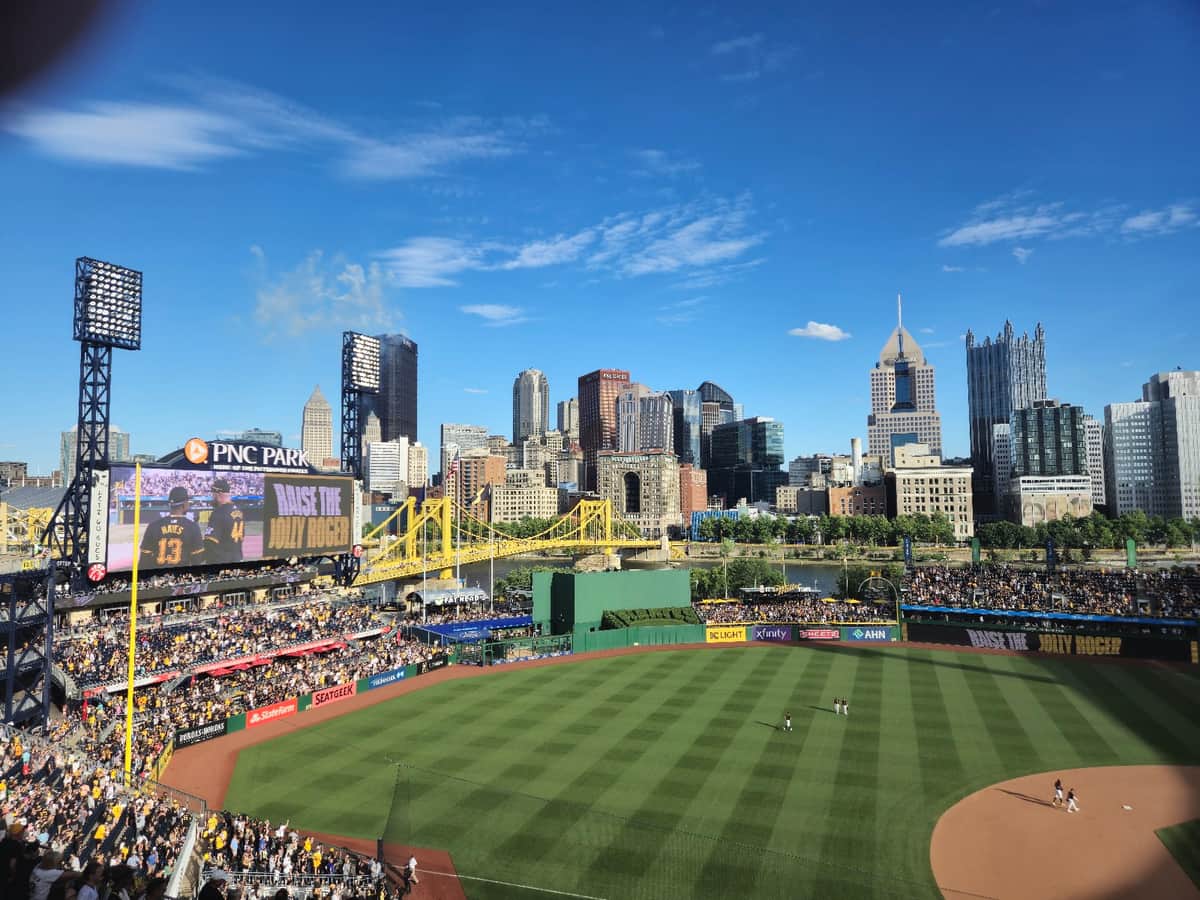 Photo: Gavin Sommers / Google MapsBaseball
PNC Park
Pittsburgh, USA 38,747
PNC Park, home of the Pittsburgh Pirates, seats 38,747 for baseball in a compact two-deck bowl, one of the smallest capacities in Major League Baseball. On the PNC Park seating chart the lower deck holds the Field Level boxes (sections 1 to 32) in front of the Box Level (101 to 132), with the left-field bleachers (133 to 138) and right-field Outfield Reserved seats (139 to 147) beyond the fences. The upper deck starts with the 200 Level, including the Pittsburgh Baseball Club Level (207 to 228), and rises to the Grandstand (301 to 333) and the Rooftop above left field. Around 26,000 of the seats are on the first level and every seat outside the bleachers looks out at the Pittsburgh skyline. The Pirates dugout is on the third-base side, which is also the side with the best line to the city and bridges. The best overall seats are the infield sections between the dugouts (Home Plate Club, Dugout Boxes and Infield Box 109 to 124); the best value is the Grandstand infield (309 to 323), where the view from your seat takes in the whole field, the river and the skyline.
Seating guide Photo: Google MapsBaseball
Rogers Centre
Toronto, Canada 39,150
Rogers Centre is the retractable-roof home of the Toronto Blue Jays and one of Toronto's biggest concert venues. Following the major 2022–2024 renovations, baseball capacity is approximately 39,150, with seating arranged across the 100 Level (field level), the 200 Level (club/mezzanine), the suite-only 300 and 400 Levels, and the steep 500 Level (upper deck); the outfield now features re-oriented seats plus social spaces and bars. The best baseball seats are the renovated 100 Level infield and premium dugout sections (around 113–130) directly behind the dugouts and home plate, while the best value sits in the 500 Level behind home plate (around 522–526) and in the outfield corners. For concerts, the retractable roof allows configurations from intimate theatre setups to full stadium shows of up to roughly 55,000, with the lower bowl and floor general admission delivering the strongest experience.
Seating guide Photo: Brittany Woodward / Google MapsBaseball
T-Mobile Park
Seattle, USA 47,929
T-Mobile Park seats about 47,929 across the Main level (100s), the Club level (200s), and the View level (upper, 300s), plus outfield bleacher areas and the Pen. Lower-level infield seats are the best overall, the outfield is the spot for home runs, and the View level offers value with skyline and mountain views. Its retractable roof covers the field against Seattle rain without fully enclosing the park, so games rarely get rained out but stay open-air in feel. It also hosts concerts and events.
Seating guide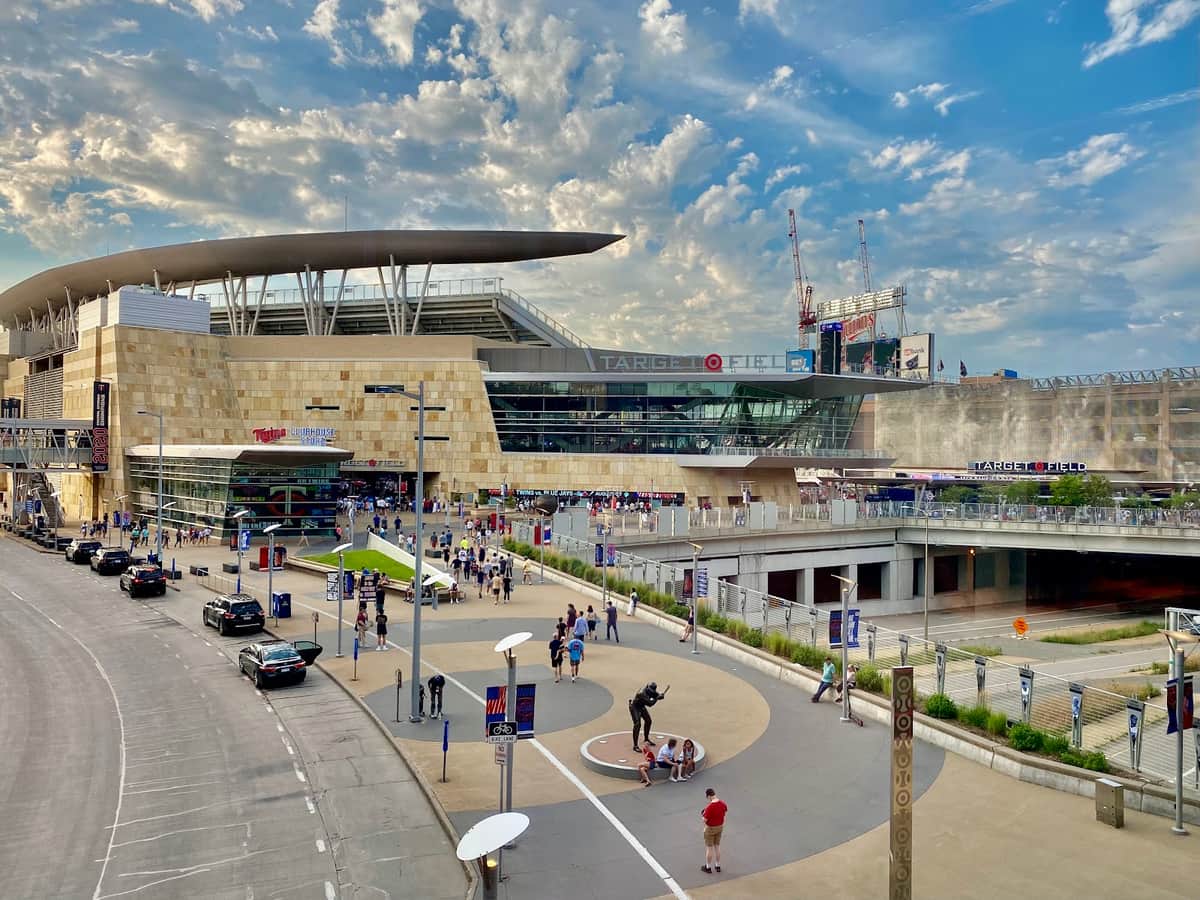 Photo: Ton Kramer / Google MapsBaseball
Target Field
Minneapolis, USA 38,544
Target Field is the home of the Minnesota Twins, with a seating capacity of 38,544. The Target Field seating map has five levels: the Main Level (field sections 1 to 17 and sections 101 to 140), the Club Level (lettered sections A to V, with the Thrivent Club in A to R), the Premier Suite Level, the Terrace Level (201 to 240) and the View Level (301 to 334). Sections are numbered clockwise from the right field foul pole. The best seats for baseball are the infield sections between the dugouts, including the UnitedHealthcare Champions Club (sections 7 to 10) behind home plate, while the Terrace and View Level infield sections are the best value. For concerts the field is covered and used for floor seating, and the layout changes by show.
Seating guide Photo: Alejandro Escobar / Google MapsBaseball
Wrigley Field
Chicago, USA 41,649
Wrigley Field seats about 41,649 across Field Boxes (lower, 100-level), the Terrace level (200s), the Upper Deck (300/400s) and the famous outfield Bleachers. Lower field boxes behind and near home plate are the best overall, the bleachers are the classic spot for home runs and party atmosphere, and the upper deck offers value with a view of the skyline and the neighborhood rooftops. As an open-air day-game institution, sun and the swirling lake wind matter, and the third-base side generally finds shade earlier. The park also hosts concerts, the NHL Winter Classic and college football.
Seating guide Photo: Shelli Saenz / Google MapsBaseball
Yankee Stadium
New York City, USA 46,537
Yankee Stadium, opened in 2009 in the Bronx, is the home of MLB's New York Yankees and the interim home of MLS side New York City FC, and it regularly stages major concerts and college-football fixtures such as the Pinstripe Bowl. Seating is arranged across a two-bowl design: the lower bowl comprises the Field Level (including the ultra-premium Legends Suite seats in the first rows) and the Main Level (the 200s), while the upper bowl is formed by the Terrace Level and Grandstand Level (the 300s and 400s), with luxury suites on the H&R Block Level between them and bleachers beyond the outfield fences. The best views are from the Field Level infield close to home plate, while the Main Level infield corners (around sections 213, 214, 223 and 224) and the Terrace Level offer the best value with similar sight lines at a fraction of the price. Around two-thirds of the seating sits in the lower bowl, and most lower-level seats benefit from shade and rain cover thanks to the overhang of the level above.
Seating guideBasketball
1 venues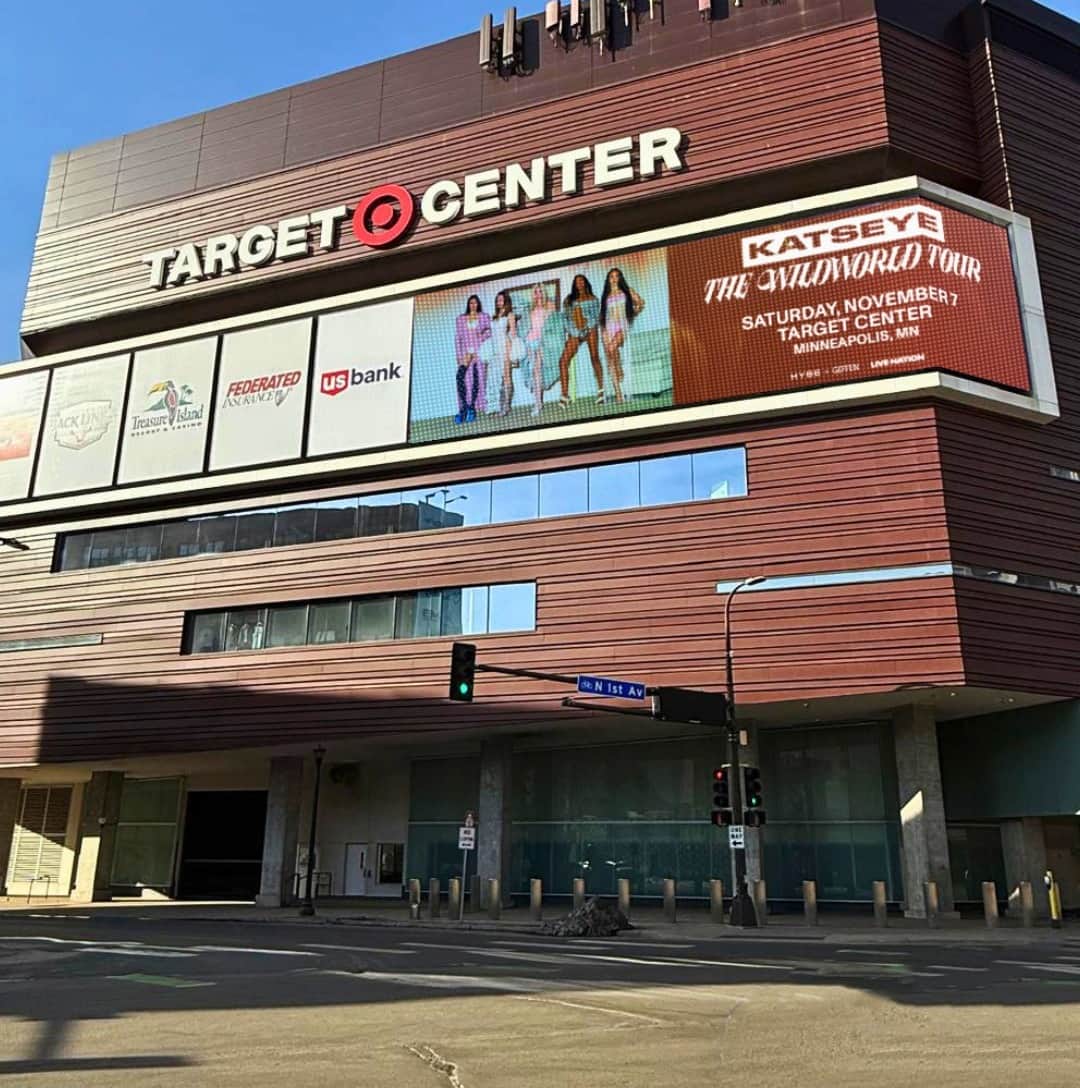
Tennis
8 venuesPhoto: Randolfo Santos · / Google MapsTennisArthur Ashe Stadium
New York City, USA 23,771
Arthur Ashe Stadium, the main court at the USTA Billie Jean King National Tennis Center in Flushing Meadows, Queens, is the world's largest tennis stadium with a capacity of around 23,771. It is arranged in four distinct tiers stacked from the floor upwards: the Courtside (lower) level, the Suite level, the Loge level and the large Promenade (upper) level, all sitting beneath a retractable roof completed in 2016. The best overall views are from the Courtside boxes and Loge sections behind the baselines and along the sidelines close to the umpire's chair, while the best value is found in the lower rows of the Promenade level, where prices fall sharply but sightlines remain reasonable. For day sessions, the west and south sides (broadly Sections 47-58 and the matching Promenade sections) move into shade by mid-afternoon, whereas the highest Promenade rows feel very distant from the court. The standout recommendation is to sit as low as possible on whichever tier your budget allows and to favour baseline or near-baseline sections over the extreme corners.
Seating guide Photo: Radu 083 / Google MapsTennis
Caja Mágica (Manolo Santana)
Madrid, Spain 12,442
The Caja Mágica ("Magic Box"), designed by French architect Dominique Perrault and opened in 2009, is the permanent home of the Mutua Madrid Open. Its centre court, the Estadio Manolo Santana, holds approximately 12,442 spectators and is wrapped around a single clay court in a steep, intimate bowl with a retractable roof. Seating is split into a Lower tier (B-level blocks B1–B24 plus the front rows of the A-level) and an Upper tier (A-level blocks A1–A24), with blocks numbered around the bowl. The best views are courtside and in the low Lower-tier rows along the sidelines; the best-value seats are the higher rows of the Upper A-level, while shade arrives earliest on the west side and the north end of the stadium. Premium options include Platinum Seats, rooftop Sky Seats and DO&CO-catered VIP Boxes.
Seating guide Photo: Google MapsTennis
Centre Court, All England Lawn Tennis Club
London, England 14,979
Centre Court is the most famous stadium in tennis, an intimate grass arena seating just under 15,000 across a lower tier, a middle band and an upper tier wrapped tightly around the court. The Royal Box sits at the south end. Since 2009 a retractable roof lets play continue in rain and under lights. The atmosphere is famously hushed during points and then thunderous, and it hosts the Wimbledon singles finals and the marquee matches of the fortnight.
Seating guide Photo: Bryan Hoybook / Google MapsTennis
Court Philippe-Chatrier
Paris, France 15,000
Court Philippe-Chatrier is Roland-Garros's centrepiece, a roughly 15,000-seat clay amphitheatre wrapped in three main tiers. The tournament sells seats by numbered price category rather than by named stand, so the closer to the court and the baseline you sit, the higher the category. Since 2020 a retractable roof shelters play from rain and enables floodlit night sessions. The atmosphere builds from polite daytime crowds to a partisan roar for French players and the finals, which are the court's flagship events.
Seating guide Photo: paolo bobbio / Google MapsTennis
Foro Italico (Centrale)
Rome, Italy 10,500
The Centrale (Campo Centrale / Stadio Centrale) at Rome's Foro Italico is the centre court of the Internazionali BNL d'Italia (Italian Open), rebuilt for the 2010 tournament with a standard capacity of around 10,400-10,500 seats. The bowl is ringed by four main sides: the Tribuna Monte Mario on the west sideline (behind the umpire's chair), the Tribuna Tevere on the east sideline (opposite the umpire), the Tribuna Internazionale behind the baseline (behind the server), and the Italian Open Club lower-level corners. The best overall views are the lower-tier sideline blocks of Tribuna Monte Mario and Tribuna Tevere, which sit closest to the action; baseline seats in Tribuna Internazionale offer a true sense of rally pace and are often better value, as are higher rows in the corners. Note that this is a clay-court arena that, as of 2026, is uncovered, so most lower-tier seats are exposed to sun and rain (a retractable roof is planned from 2027). Shaded seating tends to be on the south and west sides, including the Monte Mario stand.
Seating guide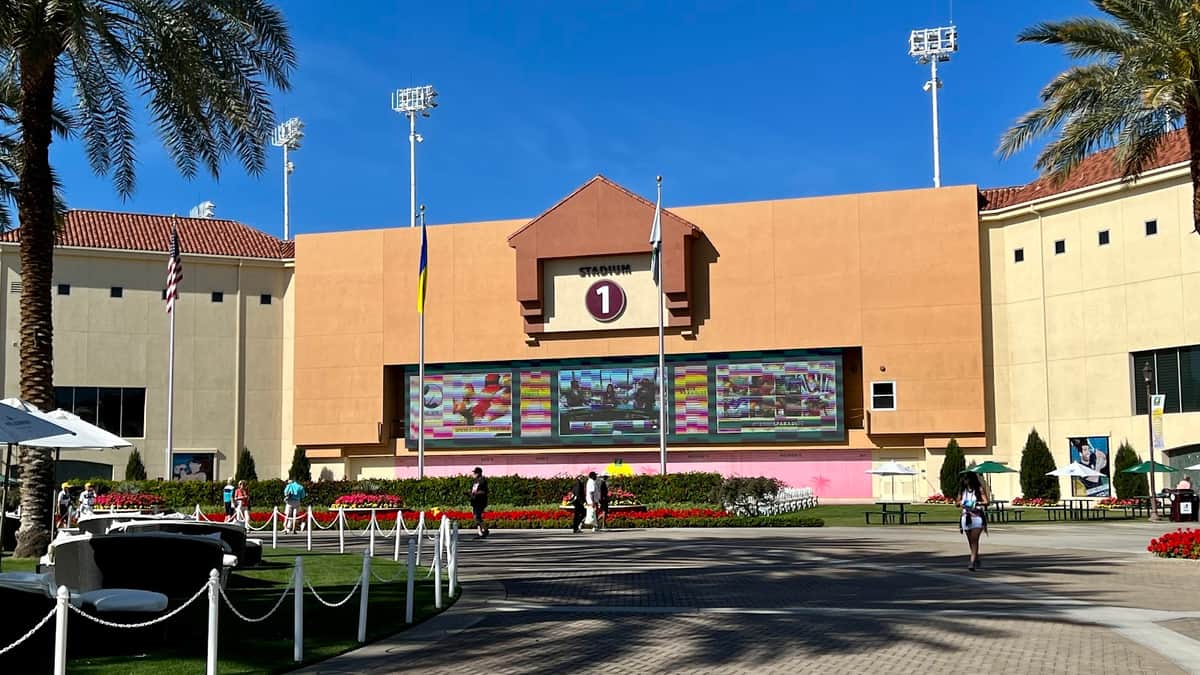 Photo: Keith Clark / Google MapsTennis
Indian Wells Tennis Garden (Stadium 1)
Indian Wells, USA 16,100
Stadium 1 is the principal show court at the Indian Wells Tennis Garden and, with a capacity of approximately 16,100, is one of the largest tennis-specific stadiums in the world (second only to Arthur Ashe Stadium). Seating rises from courtside outward and upward, with the lower bowl divided into Front Row Boxes, Premium Courtside Boxes, Courtside Boxes and Stadium Boxes (all sold by row, AA at the front through to V), then Prime Loge and Loge seating, an air-conditioned suite ring on the 200 and 300 levels, and a Grandstand/upper level at the very top. The best overall views are the lower box rows closest to the court, particularly behind the baselines for tennis; the best value sits in the upper rows of the lower level and the Loge, which also catch shade earlier in the day. Because most of the bowl is uncovered, shade exposure is a major consideration when choosing seats at this desert venue.
Seating guide Photo: sam son / Google MapsTennis
Margaret Court Arena
Melbourne, Australia 7,500
Margaret Court Arena is the third-largest show court at the Australian Open, an intimate roughly 7,500-seat arena wrapped in two tiers around a cushioned hard court. A retractable roof added in 2015 keeps play going in rain and extreme heat and enables night matches. Seats are sold by numbered category, so the lower tier near the court is the premium and the upper tier the best value. The atmosphere is lively and close, hosting marquee singles, doubles and mixed-doubles matches through the fortnight.
Seating guide Photo: drshwong / Google MapsTennis
Rod Laver Arena
Melbourne, Australia 14,820
Rod Laver Arena (Melbourne Park) holds 14,820 for tennis — the Australian Open centre court — and converts for concerts with a retractable roof that now closes in about five minutes. Seating is the Lower Level (CAT 1) and the Upper Level (CAT 2/CAT 3). Because it was purpose-built for tennis, even back-row upper seats have clean, unobstructed sightlines.
Seating guideCricket
8 venues Photo: Jono Webb / Google MapsCricket
Adelaide Oval
Adelaide, Australia 53,500
Adelaide Oval holds about 53,500 and hosts AFL (Crows and Power), cricket (including the day-night Test), and concerts. Seating is three grandstands — Western (members, west), Eastern (largest, east) and Riverbank (south) — plus The Hill, a heritage grass embankment at the northern end. Bays use 100s (Level 1) up to 500s (upper), numbered around the oval. The Riverbank Stand sits behind the bowler’s arm for cricket; halfway-line lower bays are best for AFL.
Seating guide Photo: The Gabba / Google MapsCricket
Brisbane Cricket Ground
Brisbane, Australia 42,000
The Gabba is a fully enclosed circular bowl holding around 42,000 (about 36,000 for cricket), so the seating runs as a continuous ring rather than separate grandstands. The best batting views are behind the bowler's arm at the Vulture Street and Stanley Street ends, the Members Reserve on the western side offers the best shade and facilities, and the upper bowl is the best value. It hosts the traditional first Test of the Australian summer, one-day and T20 internationals, Brisbane Heat BBL and Brisbane Lions AFL.
Seating guide Photo: Adnesh Ghawali / Google MapsCricket
Eden Gardens
Kolkata, India 68,000
Eden Gardens is one of the great cathedrals of cricket, a roughly 68,000-seat three-tier bowl famous for its deafening, passionate crowds. The B.C. Roy Club House holds the members on the western side, while the lower and upper tiers are arranged in lettered public blocks and stands renamed for Bengal cricket greats. Straight blocks behind the bowler's arm give the best batting views, the upper tiers are the best value, and covered rows offer shade. It hosts India home Tests, one-day and T20 internationals and Kolkata Knight Riders IPL matches.
Seating guide Photo: Abul Hasan / Google MapsCricket
Lord's Cricket Ground
London, England 31,100
Lord's holds around 31,000 across a horseshoe of famous stands, from the members' Pavilion at one end to the tall Compton and Edrich Stands flanking the Media Centre at the Nursery End. The best batting views sit behind the bowler's arm at either end, the Grand Stand and Mound offer good value, and the Tavern is the liveliest public corner. Roofed upper rows give the best shade. It hosts England home Tests including the Lord's Test, one-day internationals, finals days and Middlesex county cricket.
Seating guide Photo: Google MapsCricket
Melbourne Cricket Ground
Melbourne, Australia 100,024
The MCG holds 100,024 and hosts AFL (including the Grand Final), cricket, concerts and — from 2026 — the NFL. Seating runs across four levels lettered M (Level 1) to Q (Level 4) and four stands. The consensus best general-admission view is the Level 2 (N) centre-wing, while Level 4 (Q) is the best value with full panoramic views.
Seating guide Photo: Google MapsCricket
Narendra Modi Stadium
Ahmedabad, India 132,000
The Narendra Modi Stadium is the largest cricket ground on earth, a round 132,000-seat bowl with two vast tiers giving a 360-degree view. The best batting views are at the ends behind the bowler's arm, the upper tier is the best value and partly covered, and club-level and corporate blocks offer the most comfort. The sheer scale means side blocks are a long way from the pitch. It hosts India Tests, including day-night pink-ball matches, major internationals (including the 2023 ODI World Cup final) and Gujarat Titans IPL games.
Seating guide Photo: Google MapsCricket
Optus Stadium
Perth, Australia 61,266
Optus Stadium seats around 60,000 in a modern three-tier oval bowl with a roof that covers most spectators. The best batting views are behind the bowler's arm at either end, the club-level middle tier offers the best comfort, and the upper tier is the best value and well sheltered. Some lower sections stay exposed to the sun. It hosts Test and day-night international cricket, Perth Scorchers BBL, and AFL for the West Coast Eagles and Fremantle Dockers, plus major concerts.
Seating guide Photo: Daniel / Google MapsCricket
Sydney Cricket Ground
Sydney, Australia 48,000
The SCG holds around 48,000 across a ring of historic and modern stands, from the members-only Pavilion and Ladies Stand on the west to the Victor Trumper, Bill O'Reilly and Brewongle stands around the rest of the ground. The best batting views sit behind the bowler's arm at the members' end, while the Trumper Stand on the site of the old Hill is the liveliest general area. Afternoon sun catches the eastern side. It hosts the New Year's Test, one-day and T20 internationals, Sydney Sixers BBL games and Sydney Swans AFL.
Seating guideArenas & concerts
54 venues Photo: 3Arena / Google MapsArena
3Arena
Dublin, Ireland 13,000
The 3Arena holds about 13,000 for a fully standing show or around 9,000 fully seated. The floor is flat and can be standing general admission or seated on retractable platforms, wrapped by a tiered bowl of blocks that rises steeply for good sightlines. The best concert views come from the front of the floor and the lower blocks facing an end stage, while the highest back rows and behind-stage sections sit far from the action. Ireland's flagship indoor arena, it hosts major concerts, comedy and family shows.
Seating guide Photo: Google MapsArena
Accor Arena
Paris, France 20,300
The Accor Arena holds up to around 20,300 for concerts, with capacity dropping to roughly 15,000-16,000 for tennis and other sports when a central court or ring replaces the stage. Seating rises from a floor (standing or seated) through numbered lower and upper tiers, and the best concert views are from the lower blocks facing an end stage and the front of the floor. The upper ring climbs steeply, so the highest and most side-on blocks feel distant. A Paris institution, it hosts major concerts, the Rolex Paris Masters tennis and elite basketball and handball.
Seating guide Photo: Frederik / Google MapsArena
AFAS Dome
Antwerp, Belgium 18,575
The AFAS Dome, known for 92 years as the Sportpaleis, is Belgium's flagship arena: a vast elliptical hall seating 18,575 for sports and holding up to 23,001 with standing for concerts. Billboard ranked it the world's second most visited event hall in 2007-08, behind only Madison Square Garden, and it hosts around 200 events a year from major concert tours to the Diamond Games tennis and the World Gymnastics Championships. Seating is organised into a lower tier and an upper balcony wrapped in colour-coded zones rather than named stands.
Seating guide Photo: Afterpay Arena / Google MapsArena
Afterpay Arena
Sydney, Australia 21,032
Afterpay Arena, known as Qudos Bank Arena until July 2026 and before that as Allphones Arena, Acer Arena and the Sydney SuperDome, is Australia's largest indoor arena: about 18,000 seats in the bowl and up to 21,032 with the floor in play. It sits at Sydney Olympic Park and is the default Sydney stop for arena tours, as well as home to the Sydney Kings and Sydney Flames. The seating is easy to read once you know the numbering. The Arena Floor on the Lower Ground level carries the lettered floor blocks, A through J, which are flat rather than raked. Above it, the Ground Level main concourse holds sections 1 to 20, Level 1 holds sections 21 to 52, and Level 3, the upper concourse, holds sections 53 to 84. Lower numbers in each of those rings sit nearest the stage end for a standard end stage concert, so a section in the low teens on the Ground Level is a very different seat from one in the high teens. Entry A leads into the Grand Foyer and Entry B into the Northern Foyer, with a separate corporate suite entry on Level 4 from the P1 car park.
Seating guidePhoto: Rakesh Singh / Google MapsArenaAO Arena
Manchester, England 21,000
The AO Arena holds up to around 21,000 for concerts, with a full lower and upper tier wrapping 360 degrees around a floor that seats or, at around 6,200 standing, hosts a general-admission crowd. The best concert seats are in the lower-tier blocks facing an end stage and the front of the floor, while the upper tier (blocks 200 and above) climbs steeply and the top rows sit a long way back and high up. Formerly the MEN Arena and Manchester Arena, it is the city's flagship indoor venue for concerts, comedy, boxing and family shows.
Seating guide Photo: Frank Schubert / Google MapsArena
Arena di Verona
Verona, Italy 22,000
The Arena di Verona is a 1st-century Roman amphitheatre and the home of the annual Arena di Verona Opera Festival, with a modern summer capacity of around 22,000 (typically reduced to roughly 13,000-15,000 during opera performances once the stage occupies part of the cavea). Seating is split between numbered, chaired sectors on the lower and middle tiers and the unupholstered ancient stone steps (gradinata) higher up. The premium central stalls (Poltronissime Platinum, Gold and Silver) in the first sector offer the closest, most central views and best acoustics, while the named upper tiers (Verdi, Puccini, Rossini) give a fuller view of the staging for less. The best value lies in the Verdi and Puccini sectors, which keep proper backed seats and a good sightline, while the cheapest tickets are the unnumbered 4th, 5th and 6th sectors on the stone steps. Note that the Arena is open-air with no roof, and step seats have no backrests, so a cushion is recommended for the gradinata.
Seating guide Photo: Christian “elDuderino” / Google MapsArena
Avicii Arena
Stockholm, Sweden 13,850
The Avicii Arena is Stockholm's iconic globe-shaped arena, seating 13,850 for ice hockey and up to 16,000 for concerts inside a perfect sphere. The steep seating ring, split into the lower Stand A and upper Stand B, rises around a central floor, and a 2025 renovation added new premium hospitality spaces and gondola-style seating. The arena's separate SkyView attraction carries visitors up the outside of the dome in glass gondolas to 85 metres above the ground.
Seating guide Photo: Google MapsArena
Barclays Arena
Hamburg, Germany 13,800
The Barclays Arena is northern Germany's premier indoor venue: a modern arena holding up to 15,000 for concerts and up to 13,000 for basketball and handball, that has hosted everything from ice hockey and handball finals to the annual EHF Finals Men. Its two-tier bowl of lower (U) and upper (O) blocks wraps the floor closely, with the floor itself split into seated blocks (I1–I12) or opened up for standing at the biggest shows.
Seating guidePhoto: Google MapsArenaBarclays Center
Brooklyn, USA 17,732
Barclays Center in Brooklyn is a two-tier arena seating around 17,700 for Brooklyn Nets basketball and up to roughly 19,000 for concerts. The bowl is split into a Lower Level (the 100s, sections numbered roughly 1-31) wrapped by a 200 Level upper tier (sections in the 200s), with courtside seats, premium Loge Boxes (L1-L5) and a ring of luxury suites between the two decks. The best overall views for Nets games are the centre-court Lower Level sections (around 7, 8, 23 and 24), while the strongest value sits in the Lower Level corners and the lower rows of the 200 Level along the sides. Avoid the baseline sections behind the baskets and, for concerts, sections directly behind the stage. Premium hospitality includes the Calvin Klein Courtside Club and the 40/40 Club.
Seating guide Photo: SPCA663 Little B / Google MapsArena
Capital One Arena
Washington, D.C., USA 20,356
Capital One Arena seats roughly 20,000 for Wizards basketball and about 18,500 for Capitals hockey, built as a 100 (lower), 200 (club/mezzanine) and 400 (upper) level bowl, with no 300 level in the seating numbering. The lower bowl carries the price and atmosphere, the 200 level offers strong club-style views, and the 400 level is the affordable upper deck. The building is famous for loud Capitals playoff crowds and the outdoor viewing parties in the plaza. It hosts the Wizards, Capitals, Georgetown basketball, concerts and events.
Seating guide Photo: Mr Blue Bot 7 / Google MapsArena
Chase Center
San Francisco, USA 18,064
Chase Center seats about 18,064 for Warriors basketball across a compact two-tier bowl of a lower level (low-numbered sections) and an upper level (100- and 200-series sections), plus courtside, theater boxes and premium clubs. It is one of the newest and most amenity-rich arenas in the NBA, with excellent sightlines and a lively but generally less deafening crowd than older barns. Lower-bowl sideline seats are the prime tickets, while the upper level offers the best value with clean views. It hosts the Warriors plus major concerts and events year-round.
Seating guide Photo: Google MapsArena
Co-op Live
Manchester, England 23,500
Co-op Live holds up to 23,500 with a standing floor, or about 20,500 fully seated, making it the largest indoor arena in the UK. The steep, tightly wrapped bowl has a lower tier, an upper tier and an unusually deep offering of premium clubs and boxes, with the best concert views from the lower blocks facing an end stage and the front of the floor. As a purpose-built music venue, the upper tier still climbs high, so the very back rows sit well above the stage. It is used for major concerts, comedy and live events, and hosted the BRIT Awards after its 2024 opening.
Seating guide Photo: x-tina / Google MapsArena
Crypto.com Arena
Los Angeles, USA 18,997
Crypto.com Arena seats roughly 18,997 for Lakers basketball and about 18,230 for Kings hockey, arranged as a 100 (lower), Premier/suite (200) and 300 (upper) level bowl. The lower bowl and celebrity-lined courtside carry the glamour, while the 300 level is steep but keeps full views of the floor. The building is also home to the LA Sparks; the Clippers moved out to the Intuit Dome in 2024. It is one of the busiest arenas in the world, hosting the Lakers, Kings, Sparks, major concerts and award shows.
Seating guide Photo: Google MapsArena
First Direct Arena
Leeds, England 13,781
First Direct Arena is a 13,781-capacity arena whose fan-shaped bowl brings every seat face-on to the stage — no seat looks along the stage from the side, and none is more than about 68 metres from it. That geometry, plus roughly fifteen retractable rows on the flat floor, makes it one of the most evenly sighted arenas in the United Kingdom. In July 2025 the venue was restyled 'first direct bank arena' under a naming-rights extension to 2031.
Seating guide Photo: Erik Wilde / Google MapsArena
Hallenstadion
Zürich, Switzerland 11,200
The Hallenstadion is Zürich's historic indoor arena: a steep single bowl seating 11,200 for ice hockey, 12,000 for handball and up to 13,000 for concerts, with a maximum event capacity of around 15,000. Seating wraps the bowl in a lower tier (blocks with a 1 or 0 suffix, such as A1 or W0) and an upper tier (blocks with a 2 suffix, such as K2 or T2), with the floor split into Parkett 1, 2 and 3 for end-stage concerts. Its 2004-05 renovation brought modern concourses, hospitality areas and acoustics while keeping the intimate feel of a 1930s arena.
Seating guide Photo: Rachel Wheelhouse / Google MapsArena
Hollywood Bowl
Los Angeles, USA 17,500
The Hollywood Bowl is Los Angeles' historic open-air amphitheatre and the summer home of the LA Phil, with a seating capacity of about 17,500. The Hollywood Bowl seating chart climbs the hill from the John Williams Stage. At the front is the Pool Circle, then the Garden Boxes, Promenade 1, the Terrace Boxes (flanked by sections D and E), Promenade 2, and the Super Seats in the centre (sections G1, H and J1) with sections F1 to F3 and K1 to K3 either side. Above Promenade 3 the bench sections carry on up the hill, lettered L, M, N and P, then Q to U, then V, W and X at the top. Box seats have folding chairs and room for a picnic, the Super Seats are cushioned theatre style seats with backs and arms, and the upper benches are the furthest from the stage, where the video screens do much of the work. Side boxes beside Ramps A and E give an angled view close to the stage.
Seating guide Photo: Google MapsArena
Kia Forum
Inglewood, USA 17,500
The Kia Forum is Inglewood's historic round arena and one of Los Angeles' best known concert venues, with a capacity of about 17,500. The Kia Forum seat chart is simpler than most arenas: there are just two seating levels, the Lower Level (sections 101 to 136) and the Upper Level (sections 201 to 236), with a ring of boxes at the front of the upper level and no suites level in between. For the usual end stage concert, the stage sits in front of lower sections 113 to 124, the floor is split into up to 13 sections (A to E at the front, F to K in the middle and 1 to 3 at the back), and sections 101, 102, 135 and 136 face the stage head on. Because the bowl is round and there is no middle tier, the front rows of the 200 Level give a clear, raised Kia Forum seating view, while the top of the upper level is a climb of up to about 30 rows.
Seating guide Photo: Θοδωρής Γαρίδας / Google MapsArena
Lanxess Arena
Cologne, Germany 20,000
The Lanxess Arena holds up to around 20,000 for concerts, making it the biggest indoor arena in Germany, with capacities of roughly 18,500-19,500 for ice hockey and handball. Seating rises steeply from a floor (standing or seated) through numbered lower and upper blocks, sometimes separated into cube sections, and the best concert views come from the lower blocks facing an end stage and the front of the floor. The upper blocks climb high, so the top and behind-stage sections feel distant. It is the home of the Kölner Haie ice hockey team and a major concert stop.
Seating guide Photo: Qu / Google MapsArena
LDLC Arena
Lyon (Décines-Charpieu), France 12,523
The LDLC Arena, planned as the largest event hall outside the Paris region, opened in 2023, seating 12,523 for basketball and up to 16,000 for concerts. Its bowl wraps the floor in steeply raked tiers with numbered blocks — 100-level sections low down and 200- and 300-level sections above — while the flat floor (the fosse) is standing or seated by event, and two hospitality ranges, Les Terrasses and Le Club & La Suite, sit above the general admission seating.
Seating guide Photo: Ke S / Google MapsArena
Little Caesars Arena
Detroit, USA 20,332
Little Caesars Arena is home to the Detroit Red Wings and Detroit Pistons, with a seating capacity of 19,515 for ice hockey and 20,332 for basketball. The Little Caesars Arena seating chart has the 100 level (sections 101 to 126) in the lower bowl, a ring of small Mezzanine sections (M1 to M34), the 200 level upper bowl (201 to 232) and, above the west side, the Michigan First Gondola boxes (G1 to G31). The Blue Cross Suites sit between the lower and upper bowls. For Red Wings and Pistons games the best views are from the 100 level sidelines, while the 200 level sidelines are the best value. For concerts the Red Wings arena map marks the stage at the Sproat Street end in front of sections 101 to 104, so the Henry Street end faces it head on.
Seating guide Photo: Google MapsArena
M&S Bank Arena Liverpool
Liverpool, England 10,600
M&S Bank Arena Liverpool is a 10,600-capacity (11,000 with floor standing) arena on the King's Dock waterfront, best known for hosting the Eurovision Song Contest 2023. Its flexible floor and two tiers let it run from an intimate 2,000-seat 'short hall' to full-house concerts, twenty-two hospitality boxes ring the bowl, and its ACC Liverpool campus setting puts bars, restaurants and hotels within a short walk.
Seating guide Photo: Mukesh Chavda / Google MapsArena
Madison Square Garden
New York City, USA 20,000
Madison Square Garden — 'The World's Most Famous Arena' — sits above Penn Station in Midtown Manhattan and holds roughly 19,800 for Knicks basketball, about 18,000 for Rangers hockey and up to ~20,000 for concerts. After its 2011–13 transformation, seating splits into the 100 Level (lower bowl) and the 200 Level (upper bowl), joined by MSG's signature Chase Bridges — two suspended seating decks that hang over the lower bowl. The best balance of price and view is the lower 100 Level along the sideline/center; the 200 Level is famously steep but offers the cheapest full-arena views.
Seating guide Photo: Google MapsArena
MEO Arena
Lisbon, Portugal 20,100
The MEO Arena is Portugal's largest indoor venue: a 20,100-capacity concert arena with a steep modern bowl around a flexible floor that scales from around 5,500 for intimate shows up to full arena capacity. Built for Expo '98, it hosts the country's biggest concert tours as well as futsal, basketball, tennis and major congresses.
Seating guide Photo: Google MapsArena
Moda Center
Portland, USA 19,393
Moda Center is home to the NBA's Portland Trail Blazers and seats 19,393 for basketball. The Moda Center seating chart is simple once you know the levels: the lower bowl below the suites is split into the 100 level (sections 101 to 122) and the 200 level (sections 201 to 230), the Columbia Bank Suite Level sits above them, and the 300 level (sections 301 to 334) forms the upper bowl above the suites. The 200 level sideline sections are the Club Level, with extra legroom, their own concourse and two full bars. For basketball the best all round views are in the 100 level sidelines, while the 300 level sidelines are the best value. For end stage concerts the official seat map places the stage at the north end, so the south end sections face it head on.
Seating guide Photo: Google MapsArena
Motorpoint Arena Nottingham
Nottingham, England 10,000
Motorpoint Arena Nottingham is the East Midlands' biggest live entertainment venue, holding 10,000 for music (and up to 15,865 including standing room). Attached to the National Ice Centre, it doubles as the home of the Nottingham Panthers and hosts everything from Premier League Darts to major concert tours in a classic two-tier bowl around a flat floor, with executive suites overlooking the action from the concourse level.
Seating guide Photo: Amin Mukhtar / Google MapsArena
Olympiahalle München
Munich, Germany 12,500
The Olympiahalle is Munich's historic indoor arena: a single steep bowl of 12,500 to 15,500 seats depending on configuration, beneath the tent-style acrylic-glass roof of the 1972 Olympic Park. The bowl uses paired letter-number blocks (such as E2 or F1) wrapped around a central floor, with perimeter standing (Umgriff) added around the top concourse for the biggest concerts.
Seating guide Photo: OVO Hydro / Google MapsArena
OVO Hydro
Glasgow, Scotland 14,300
The OVO Hydro has a maximum capacity of about 14,300, made up of roughly 12,300 seats plus around 2,000 standing on the floor. Seating rises in a steep circular bowl over the floor, with a lower level and upper level of numbered blocks, and the best concert views come from the floor and the lower-tier blocks facing an end stage. The upper-level 200 and 300 blocks climb quickly and the highest rows feel distant. It is Scotland's flagship indoor arena for concerts, comedy and live events, having become one of the world's most-attended venues.
Seating guide Photo: Daniel Albuquerque / Google MapsArena
P&J Live
Aberdeen, Scotland 10,264
P&J Live is Scotland's largest indoor arena at 10,264 capacity, part of the £333 million TECA events campus that opened in August 2019 beside Aberdeen Airport. Its hall converts from concerts to three 2,000-square-metre exhibition halls via automated retractable seating, wheelchair and ambulant seating positions move with each event's layout, and the campus includes premium suites such as ShowDeck and 14 on 1st, a 195 Bar & Grill restaurant, and two on-site hotels.
Seating guide Photo: pere guiu / Google MapsArena
Palau Sant Jordi
Barcelona, Spain 17,960
The Palau Sant Jordi seats about 17,960 for concerts and around 16,000-17,000 for sport, with an even higher maximum when a standing floor is used for the largest shows. Seating rises around the floor (pista) through lower and upper stands (gradas), and the best concert views come from the lower stands facing an end stage and the front of the floor. The upper stands climb steeply, so the highest and behind-stage blocks feel distant. A flexible Olympic venue, it hosts major concerts, basketball, tennis and international sport.
Seating guide Photo: jean-louis KAMP / Google MapsArena
Paris La Défense Arena
Nanterre (Paris), France 30,681
Paris La Défense Arena in Nanterre is Europe's largest indoor arena, opened in 2017 and home to rugby's Racing 92 as well as a flagship concert venue. Its distinctive U-shaped bowl wraps around three sides, with seating split between the Lower Stands on level 1 (blocks numbered roughly 101–118), private Suites and Boxes on level 2, and the Upper Stands on level 4 (blocks numbered roughly 401–421); for concerts a flat floor (Parterre/Fosse) is added in front of an end stage. The best overall seats are in the central Lower Stands for rugby, or the front-centre floor blocks for concerts, both giving straight-on, elevated-to-eye-level views; the best value typically sits in the Upper Stands, which still benefit from the venue's acclaimed acoustics and sightlines. Atmosphere is strongest in the central lower tier behind the posts for rugby and on the floor near the stage for concerts. Seats high in the Upper Stands and at the open (stage-end) corners are the ones to approach with care.
Seating guide Photo: Raja R / Google MapsArena
PPG Paints Arena
Pittsburgh, USA 18,187
PPG Paints Arena is the downtown Pittsburgh home of the NHL's Pittsburgh Penguins. It opened in 2010 as Consol Energy Center and seats 18,187 for hockey, about 19,000 for basketball and up to 19,758 for concerts. The PPG Paints Arena seating chart is a simple two-tier bowl: the 100 Level lower bowl (sections 101 to 122), a ring of loge boxes and suites, and the 200 Level upper bowl (sections 201 to 234). For hockey, the best seats are the centre ice club sections 101 to 103 and 111 to 113. Penguins fans often choose 106 to 108, behind the net the home side attacks twice, and the front rows of the 200 Level sidelines (201 to 204 and 218 to 221) give the best value seat view in the building. For end stage concerts, the published chart puts the stage at the Fifth Avenue end, so the Centre Avenue end sections face it head on.
Seating guide Photo: Olga Giba / Google MapsArena
RAC Arena
Perth, Australia 15,000
RAC Arena, still called Perth Arena by plenty of locals, is Western Australia's main indoor arena: a compact, steep bowl on Wellington Street at the northern edge of the Perth CBD, holding up to 15,000 for a concert, 14,846 for basketball and 13,910 for tennis. It opened in 2012, it has a retractable roof, and its folded facade was drawn from the Eternity puzzle. The seating layout is straightforward. Numbered floor blocks sit on the arena floor for concerts, the 200 level is the lower bowl ring closest to the action (sections 201 to 222), and the 300 and 400 levels sit above it in the upper bowl (301 to 323 and 401 to 407). Because the bowl is small and steeply raked, the difference between the best and worst seat here is smaller than at the eastern states arenas. For an end stage concert the sweet spot is the lower bowl sections closest to the stage, 203 and 215 first, then 204 and 214, which give you a better view than most of the floor. For Perth Wildcats and West Coast Fever games the side on 200 level sections are the pick.
Seating guide Photo: Dinesh I / Google MapsArena
Red Rocks Amphitheatre
Morrison, USA 9,525
Red Rocks Amphitheatre is a 9,525 capacity open air concert venue carved between Creation Rock and Ship Rock in the foothills near Morrison, Colorado, owned and run by the City and County of Denver. The Red Rocks seating map is simple: there are no sections, just 70 curved rows of wooden benches rising from Row 1 at the foot of the stage to Row 70 below the Top Plaza, about 100 feet higher. Rows are widest in the middle of the bowl (the official map marks Row 50 running to seat 153) and narrow towards the front and back. Seating charts vary by event: some shows are reserved by row and seat, others are general admission. There is no roof over the seats, the stage has a roof, and two I-MAG screens beside the stage can be seen from every seat.
Seating guide Photo: Zoe Askew / Google MapsArena
Royal Albert Hall
London, England 5,272
The Royal Albert Hall is London's most famous concert hall, seating 5,272 across an elliptical auditorium that mixes an arena floor, a raked Stalls tier, private boxes on three levels, the top Rausing Circle and the standing Gallery. Every seat is close to the stage by arena standards, and the domed room is renowned for its acoustics, particularly for classical music and the BBC Proms.
Seating guide Photo: Ann Sandin / Google MapsArena
Royal Arena
Copenhagen, Denmark 12,500
The Royal Arena is Denmark's great modern concert arena: a flexible wood-clad hall seating 12,500 for sport and scaling to 17,000 for concerts. The audience sits on three sides of the stage across Level 1 and Level 3, with the floor used for standing or seating, and the arena's configuration can extend all the way around for special events. A range of hospitality spaces, including the Vinyl Room lounge and private suites, sit apart from the general seating.
Seating guide Photo: Google MapsArena
Scotiabank Arena
Toronto, Canada 19,800
Scotiabank Arena seats about 19,800 for Raptors basketball and roughly 18,819 for Maple Leafs hockey, built as a 100 (lower), 200 (suite and theatre) and 300 (upper) level bowl. The lower bowl carries the atmosphere and price, the 200 level is largely premium suites and theatre boxes, and the 300 level offers affordable, if high, seats with full views. Maple Leaf Square outside creates a huge outdoor viewing crowd for playoff games. It is the shared home of the Raptors and Maple Leafs plus concerts and events.
Seating guide Photo: J.T. Lambrou / Google MapsArena
Spectrum Center
Charlotte, USA 19,077
Spectrum Center is the Uptown Charlotte home of the NBA's Charlotte Hornets, listed by NBA.com at 19,077 seats for basketball before a 2024-25 renovation added about 1,400 more lower-level seats. The Spectrum Center seating chart has two seating levels: the lower level (sections 101 to 118) wraps the court, with courtside and club rows in front, and the upper level (sections 201 to 233) rises above the Novant Health Suite Level. For Hornets games the best seats are the lower sideline sections 104 to 106 and 113 to 115, with 105 and 114 at centre court, while the best value is the lower rows of the upper sideline sections either side of midcourt (207 to 210 and 224 to 227). The seating view from the lower level is good all round, because even the baselines rise steeply and are split by an aisle behind each basket, so nobody sits directly behind the hoop. For concerts the floor is added in front of an end stage, and every seat in the bowl was replaced during the renovation.
Seating guide Photo: Sphere / Google MapsArena
Sphere
Las Vegas, USA 17,600
Sphere (Las Vegas, opened 2023) is a one-of-a-kind venue: a 17,600-seat dome (about 18,600 capacity in most configurations) wrapped on the inside by a 16K floor-to-ceiling LED screen, with Sphere Immersive Sound and roughly 10,000 'haptic' seats that move and vibrate with the show. Because the screen wraps the whole interior, there are no truly obstructed views — but where you sit changes how much of the wraparound image you take in. The consensus best seats are the center 200 Level (and center 300, e.g. Section 306) at mid-height, where you see the stage and the full sweep of the screen as intended.
Seating guide Photo: Trifin Sergieff / Google MapsArena
State Farm Arena
Atlanta, USA 16,888
State Farm Arena is the home of the NBA's Atlanta Hawks, with an official seating capacity of 16,888 for basketball and 15,590 or more for concerts. The State Farm Arena seat map has two main levels: the 100 Level (sections 101 to 122) around the court and the 200 Level (sections 201 to 227) above it, with courtside Floor seats in the Delta SKY360 Club. Unusually, the suites and clubs are stacked on one side: behind sections 106 to 110 sit the Veranda Suites, Loft Suites, party suites and Topgolf Swing Suites, so the 200 Level on that side (207 to 211) is set further back. The opposite side has the Players Club in sections 118 to 120 and the Sharecare Social Club seats between the levels. Centre court is at sections 108 and 119.
Seating guide Photo: Malcolm Rojas Vega / Google MapsArena
T-Mobile Arena
Las Vegas, USA 17,500
T-Mobile Arena is the home of the NHL's Vegas Golden Knights, with a seating capacity of 17,500 for hockey, 18,000 for basketball, 20,000 for boxing and UFC, 12,000 to 18,000 for end stage concerts and 19,500 to 20,000 for centre stage shows. The T-Mobile Arena seating chart has a lower bowl of 20 sections (numbered 1 to 20), a suite level with 44 luxury suites and more than two dozen loge boxes, and an upper level of sections 201 to 227 in a horseshoe. The two centre sections on each side, 5 and 6 and 15 and 16, are Club Seats with access to the Ghost Lounge and Bud Light Lounge. The Allegiant Flight Deck, a standing room area, runs behind sections 18 to 20 and 1 to 2.
Seating guide Photo: Y. Bayer / Google MapsArena
TD Garden
Boston, USA 19,156
TD Garden holds about 19,156 for Celtics basketball and roughly 17,565 for Bruins hockey, wrapped in a steep three-tier bowl of Loge (lower), Club (middle) and Balcony (upper). The compact footprint and low ceiling make it one of the loudest buildings in the NBA and NHL, keeping sightlines close to the action even high up. Loge along the sides gives the best all-round views, while the Balcony offers affordable if steep seats. It hosts the Celtics and Bruins plus concerts, family shows and college hockey's Beanpot tournament.
Seating guide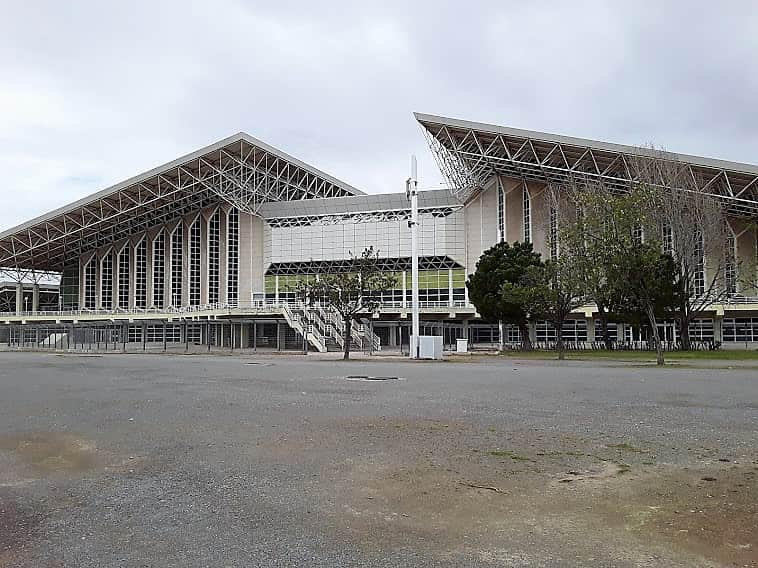 Photo: Αλέξανδρος Φλώτσιος / Google MapsArena
Telekom Center Athens
Athens (Marousi), Greece 19,250
The Telekom Center Athens, formerly the OAKA Olympic Indoor Hall, is Greece's largest indoor arena: a 19,250-capacity venue with a two-tier seating bowl beneath a distinctive A-frame roof and a glass show floor. Home to Panathinaikos B.C. and the Greek national basketball team, it has hosted the EuroLeague Final Four, the Eurovision Song Contest and a growing programme of concerts since its 2023-2026 renovation and 2025 rebrand under a naming partnership with Telekom Greece.
Seating guidePhoto: Google MapsArenaThe O2 Arena
London, England 20,000
The O2 Arena in London (capacity ~20,000; about 17,650 seated plus a standing/seated floor) is one of the busiest concert and event arenas in the world. Seating is simple: a standing or seated floor at the front, the Level 1 lower tier (blocks 101–118) wrapping it, premium suites and clubs on Levels 2 and 3 in between, and the high Level 4 upper tier (blocks 401–422) above. The best views are the front floor blocks (A1–A3) and the lower-tier blocks facing the stage; the blocks directly behind the stage (114–117) are normally not sold for concerts.
Seating guide Photo: Q C / Google MapsArena
Toyota Center
Houston, USA 18,104
Toyota Center is the home of the Houston Rockets, with a seating capacity of 18,104 for basketball and about 19,000 for concerts. The Toyota Center seating chart has two public seating levels: the large lower level (sections 101 to 126) round the court and the upper level (sections 401 to 434). Between them are two rings of suites, numbered 201 to 240 and 301 to 340, so the 200 and 300 numbers you see on the Rockets seat map are suites rather than seating sections. The Rockets Club West (sections 105 to 109) and Rockets Club East (118 to 122) take the centre of each sideline. For the best view of a Rockets game aim for the lower level sidelines or corners, and for value try the 400 level sidelines. For end stage concerts the stage usually goes at the Bell Street end, so the Polk Street end faces it head on.
Seating guide Photo: Uber Arena / Google MapsArena
Uber Arena
Berlin, Germany 14,500
The Uber Arena is one of Germany's premier indoor venues: a steep modern bowl seating 14,500 for basketball, 14,200 for ice hockey and up to 17,000 for concerts, built around a lower tier of Premium blocks (101-104), a middle tier (201-220) and an upper tier (401-421), with the Ron Barcelo Premium Lounge, Event Suites and a World Dinner Restaurant on the hospitality level.
Seating guide Photo: Marco Basso / Google MapsArena
Unipol Forum
Milan (Assago), Italy 12,800
The Unipol Forum is Milan's principal indoor arena and the home of Olimpia Milano basketball. It seats 12,800, rising to 15,800 with standing room, across a flat floor (the parterre) and three levels of steeply raked seating, with the SkyPoint VIP area and SkyBox corporate boxes above. Sectors are labelled with a letter and a number, and because sector plans change with each event's configuration, the seating map published for each show is the reference.
Seating guidePhoto: Google MapsArenaUnited Center
Chicago, USA 20,917
The United Center holds about 20,917 for Bulls basketball and roughly 19,717 for Blackhawks hockey across a 100 (lower), 200 (suite) and 300 (upper) level layout. The huge 300 level is one of the steepest and largest upper decks in the NBA and NHL, so the building feels enormous, yet the crowd noise, especially for Hawks games, is ferocious. Lower-bowl 100-level seats and the first few 300-level rows offer the best balance of view and value. It is a workhorse venue for the Bulls, Blackhawks, concerts and family shows.
Seating guide Photo: Google MapsArena
Utilita Arena Birmingham
Birmingham, England 15,800
Utilita Arena Birmingham is the city's principal indoor arena with a concert capacity of 15,800, making it one of the largest in the United Kingdom. The refurbished bowl surrounds a flexible floor with a lower and upper seating tier, plus hospitality suites and lounges on the upper levels, and its central location beside Birmingham's canal network makes it one of the easiest major arenas to reach on foot from the city centre.
Seating guide Photo: Stephen Pollock / Google MapsArena
Utilita Arena Cardiff
Cardiff, Wales 7,500
Utilita Arena Cardiff is a 7,500-capacity arena (around 5,000 seated) in the heart of the Welsh capital, hosting music, sport, comedy and family entertainment in a single-tier bowl with balcony seating on two further levels. Formerly Cardiff International Arena, it was refurbished in 2017-18, and Level 1 now carries the venue's hospitality options, including the Energise Club and The Suite Experience, alongside the L2 Restaurant & Bar on the second floor.
Seating guide Photo: craig taylor / Google MapsArena
Utilita Arena Newcastle
Newcastle upon Tyne, England 11,000
The North East's premier indoor arena seats around 11,000 for concerts, with a classic 1990s bowl layout of a flat floor, two steep seating decks and a small balcony. It has hosted concerts by David Bowie — its first show — and most major touring acts, along with basketball, ice hockey, darts and boxing.
Seating guide Photo: Google MapsArena
Utilita Arena Sheffield
Sheffield, England 13,600
Utilita Arena Sheffield is a 13,600-capacity arena, reduced to around 9,300 for ice hockey and around 3,500 in its Steel Hall configuration, and is the home of the Sheffield Steelers and a yearly stop on the Premier League Darts circuit. Its two-tier bowl around a flat floor is split into a Red concourse and a Blue concourse for orientation, and 2025-26 has brought refreshed concourse food outlets, a self-service Boxbar and a new premium tier, The Beat, launching in June 2026 alongside the existing elevated Sky's Edge seats.
Seating guide Photo: Google MapsArena
Wiener Stadthalle
Vienna, Austria 16,083
The Wiener Stadthalle's Hall D is Austria's largest indoor arena, holding up to 16,083 with floor standing. The hall has 10,741 seats (fixed and removable) across a flat floor — sold as Orchester, 1. Parkett and 2. Parkett at seated shows — an Osttribüne grandstand at the rear with 34 rows, raked Nordtribüne and Südtribüne ground-level stands with 15 rows on the sides, and first and second ring sections numbered in the 60s to 90s above.
Seating guide Photo: Santiago Alvarez Mayo / Google MapsArena
WiZink Center
Madrid, Spain 15,500
The WiZink Center holds around 15,000-15,500 for concerts and about 15,000 for basketball, with capacity varying by configuration. A steep bowl of numbered lower and upper stands (gradas) rings a floor that can be standing or seated, and the best concert views come from the lower stands facing an end stage and the front of the floor. The upper ring climbs quickly, so the highest and behind-stage blocks feel distant. It is the home of Real Madrid's basketball team and Madrid's main indoor arena for concerts and sport. Note that the venue has more recently been renamed under a new sponsor.
Seating guide Photo: M S M / Google MapsArena
Ziggo Dome
Amsterdam, Netherlands 17,000
The Ziggo Dome holds about 17,000 for concerts, with a standing or seated floor wrapped by a first ring (Eerste Ring) and second ring (Tweede Ring) of numbered blocks. Floor blocks are lettered from the front and the ring blocks run in the 100s and 200s, with the best concert views from the lower ring facing an end stage and the front of the floor. The second ring climbs steeply, so the highest and behind-stage blocks feel far from the action. Purpose-built for music, it is Amsterdam's premier arena for major concerts and live shows.
Seating guide